Showing posts with label heritage assets. Show all posts

Saturday, 25 March 2017

This is what’s at stake


National Library of Scotland has digitised historic maps for the UK. Here's a screen shot showing Straitgate in 1888 with all its hedgerows, most of which are still around today. 

But the history goes back much further, detailed in these reports to support Aggregate Industries' planning application to quarry Straitgate Farm: Archaeology and Cultural Heritage Report and Results of Archaeological Trench Evaluation: 


Here's a few more snippets from the trench evaluation:
Including the Long Range site and Areas 2 and 6 at Straitgate it is apparent that this Iron Age open settlement extends over an area of potentially c. 10 hectares... based on the geophysics and trench results, around 12-15 further roundhouses in total might be anticipated... Three pieces of Romano-British period tile from overlying deposits and two holed slates from the large ditch in Trenches 22 and 56 may indicate a ‘Romanised’ building is present in the vicinity... new evidence for Romano-British settlement was identified, dated from the artefacts recovered to the 2nd to 3rd centuries AD, including a substantial linear ditch of 30m length, c. 5m width and over 2.2m depth.
Here's a plan showing the scale of open area excavation that would need to be carried out, should AI's scheme proceed.

Tuesday, 17 March 2015

Miscellaneous

1. The Barnwell Manor Court of Appeal judgement continues to have major planning ramifications:

Following the Court of Appeal judgement in the Barnwell Manor case there is a need to give considerable importance and weight to the desirability of preserving the setting of a listed building when carrying out the planning balance. Less than substantial harm does not equate to a less than substantial planning objection... 
There is then no presumptive starting point in favour of this proposal. Because of the acknowledged harm to relevant assets (listed buildings) the approach as explained by the Court of Appeal in Barnwell and subsequently by Lindblom J in Forge Field applies so that there is a strong statutory presumption against permission being granted. 
The inspector failed to give reasons demonstrating that he had given considerable weight to the harm to the setting of each of the listed buildings that he found would be harmed to some extent by the proposed development.
the council had failed in its duty to have "special regard" to the desirability of preserving the setting of listed buildings
2. Ecotricity was denied permission for two wind turbines due to the increased risk to low flying aircraft:


3. A shortage of minerals is not by itself enough to outweigh environmental considerations, this case in Scotland concludes:

In relation to the need for minerals, the reporter conceded in his report that there was not an identified landbank of permitted quarries within the area that could meet the identified need for sand and gravel over the next ten years. Nevertheless, he concluded that the scheme’s benefits did not outweigh the significant adverse landscape and visual effects.
4. Climate change and biodiversity are important, writes Pat Ward, CEO, Aggregate Industries - just not important enough to shape the company's plans for Straitgate Farm and Woodbury Common:


5. Moving goalposts again... in this case, an approved quarry restoration scheme was varied to allow the importation of 686,000 cubic metres of inert waste:


6. In a communication received last week: "This is quite contrary to what we were told at the last Blackhill/Venn Ottery Liaison Meeting in September when we were told that Blackhill would be closing."

7. Wouldn't AI make more money going in to the Iron Age roundhouse hospitality business??


Nick Smith

Monday, 16 February 2015

Fishponds


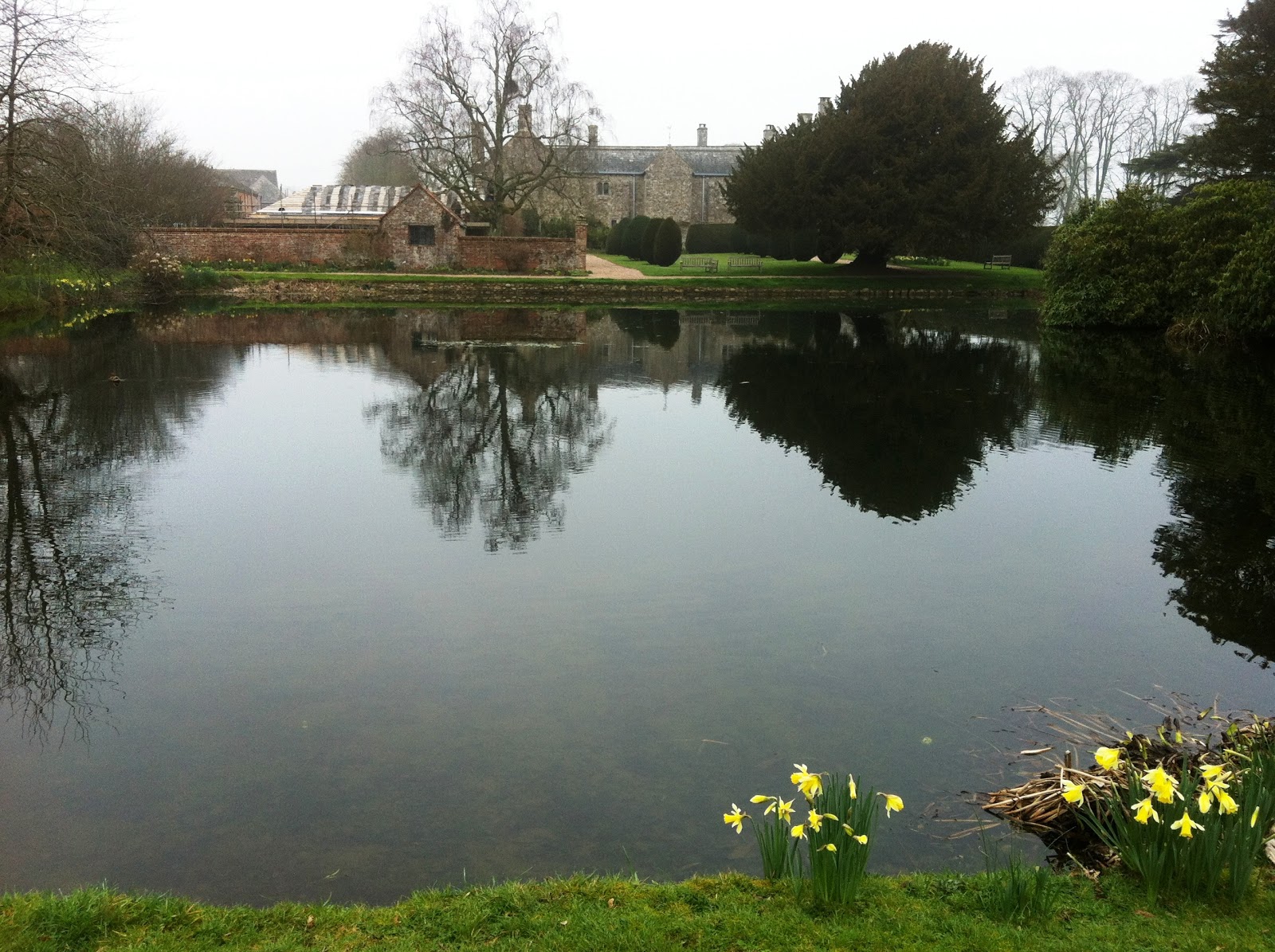
And talking of heritage assets and settings of listed buildings, this is the setting of Grade I listed Cadhay, resplendent with mediaeval fishponds in the foreground, themselves Grade II listed. What we said in our last blog would apply equally here too. A reliable supply of spring water from Straitgate, particularly during drier periods, is critical to the functioning of these ponds.


This is what was said at the Public Inquiry in 1968:
396. Cadhay is a historic house, listed as being of historic and architectual importance, and is open to the public. One of the features is the fish ponds immediately to the south of it. They are fed by the reservoir [in Cadhay Wood] and [Cadhay Wood] stream. They are not lined and water seepage takes the whole outflow. 397. It is contended that if the present water supply to the ponds were no longer sufficient to supply them they would be lost to posterity in the way in which they have existed for centuries, which would be a wanton destruction of a valuable historic monument.
The position of the spring is indicated by our arrow on ECC’s 1967 working plans below. No doubt it was in an effort to protect this water source [53] that ECC intended to leave the surrounding area unquarried.


Aggregate Industries has made no allowance yet for this spring on any plans we have seen.


Yet more for AI to subtract from its ever decreasing resource?

In 1968, the planning inspector concluded that any loss of flow to springs and streams at Cadhay "could be made good from the Straitgate lake...". [408] Without a lake, it's not exactly clear how AI could achieve that now.

Wednesday, 11 February 2015

Harm to setting of listed farmhouse already means presumption in favour of refusal


There can be no argument - quarrying Straitgate Farm would substantially harm the setting of its Grade II listed farmhouse, for ever more; surrounding fields would be removed, different levels would be introduced, screening would be ineffective, farming may no longer be viable. In 1967, Aggregate Industries (then English China Clays) wanted to bulldoze the farmhouse; today it is protected in law.

Straitgate has been farmed for more than 400 years, as copies of legal papers we have confirm. The farmhouse is thought to date back to around 1580. Part of the surrounding land is also listed, and the rest is fundamental to the setting of the farmhouse and its continuation as a working Devon farm.

In the 2012 S1-S10 site appraisals, DCC wanted us to think that "there is a medium risk of harm to the listed building which sits within an historic landscape of Barton Fields, which may require the retention of a buffer area to preserve its setting", and that nothing could be a ‘showstopper’ for S7/Straitgate. Only later, when the Sustainability Appraisal looked at the matter, did it consider that "the setting of the Grade II listed Straitgate Farm would experience a significant negative impact".

Now, in 2015, Aggregate Industries proposes that:
An impact assessment will identify the significance and sensitivity of all heritage assets affected by the proposals, and includes an impact assessment to evaluate the magnitude of change and thus direct and indirect impact on heritage assets. In particular the potential impact on the setting of designated heritage assets within 2km will be considered in relation to the Landscape and Visual Impact Assessment. If mitigation can be designed to reduce the effects of potential impacts on the settings of the statutorily protected heritage assets, then a strategy will be written and (assuming its implementation as part of the permitted scheme) the reduced residual effect will be assessed in light of the mitigation.
The issue of 'heritage assets' could be very important - not just a material planning consideration.

We mentioned the Barnwell Manor Appeal Court decision last year, but we have been reminded again by CPRE of its potential implications for Straitgate Farm. This Court of Appeal judgement upheld an earlier decision overturning permission for wind turbines in the setting of various heritage assets. CPRE, who have made representations to DCC regarding Straitgate in the past, wrote:
It is being treated as a landmark decision and is frequently referred to in subsequent planning decisions/appeals.
The importance is that it highlights the significance of the setting of a heritage asset, i.e. a listed building such as Straitgate Farmhouse. The setting includes not only views from the heritage asset, but views of the asset and its surroundings - anywhere that you get a view of the heritage asset.
The emphasis is on S66 Listed Buildings Act (1990) and the "special regard to the desirability of preserving the building or its setting". This statutory duty outweighs any policies (such as the NPPF), and as the Listed Buildings Act is worded more strongly than subsequent policies, it is helpful.
Harm to the listed farmhouse's setting would be substantial; yet, even if it were not, the judgement says:
It does not follow that if the harm to such heritage assets is found to be less than substantial, the balancing exercise referred to in policies HE9.4 and HE10.1 should ignore the overarching statutory duty imposed by section 66(1), which properly understood (see Bath, South Somerset and Heatherington) requires considerable weight to be given by decision-makers to the desirability of preserving the setting of all listed buildings, including Grade II listed buildings.
Judges ruled that once the decision-maker finds some harm to a heritage asset, that harm should be given "considerable weight", creating a "strong presumption" against the grant of planning permission.
In other words, there is a presumption in favour of refusal if harm is present.

The onus will be on AI to demonstrate that sufficiently powerful material considerations exist to justify such harm. For the decision-maker, this is not just "a simple balancing exercise but whether there is justification for overriding the presumption in favour of preservation"; preserving the setting is not a "mere material consideration to which (he) can simply attach the weight (he) sees fit in (his) judgement".

AI will also have to demonstrate that "there is no clear alternative which would generate equally powerful public benefits". If you think of AI’s extensive mineral rights in the region, covering thousands of acres, that might not be so easy; because of course there are sand and gravel deposits in other locations that wouldn’t cause as much harm, that would generate 'equally powerful benefits'.

Tuesday, 28 October 2014

‘Historic Environment Good Practice Advice in Planning’ – the MPA is not happy

The Mineral Products Association - the trade body representing quarry companies - is not happy with English Heritage. The MPA claims English Heritage’s draft Good Practice Advice (GPA) - a series of documents intended to help local authorities, applicants and other interested parties implement the historic environment policy of the National Planning Policy Framework (NPPF) - is "not in tune with the presumption in favour of sustainable development formalised by the NPPF". Its director of planning said:
It seems that English Heritage expects the planning system to protect heritage assets above all other interests and that is not how the planning system is supposed to be operating.
It is bothered that the previous advice "Mineral Extraction and Archaeology: A Practice Guide" - a document produced in 2008 by the Minerals and Historic Environment Forum (MHEF) - has been sidelined, "given only one brief mention in the draft GPA":
In complete contrast to the MHEF, the group that drafted the GPA was comprised almost entirely of heritage professionals. Unless English Heritage involves a broader range of interested parties in the production of the GPA, with a view to winning their joint endorsement to the final document, it seems unlikely that the planning system will afford much weight to what it says. That is also likely to result in a document that reflects a better balance of interests…
In other words, the MPA wants planning advice that better reflects the interests of its quarrying members, and that less reflects the interests of the UK's historic environment. The MPA champions the NPPF’s "presumption in favour of sustainable development", but that's the same document that says local planning authorities "should recognise that heritage assets are an irreplaceable resource [to be conserved] in a manner appropriate to their significance".

But what is in the draft GPA that has made the MPA so angry? Well, and bearing in mind we now have evidence of a settlement of Iron Age roundhouses at Straitgate, here are a few things that English Heritage, a statutory consultee in the planning process, says:

Note 1: The Historic Environment in Local Plans

On Local Plan site allocations - "The best way of ensuring that the selection of sites to be put forward for development supports the delivery of the conservation strategy within the Local Plan is to avoid the selection of sites that will harm the significance of heritage assets." [16]

Note 2: Decision‐Taking in the Historic Environment

On Archaeological and historic interest - "Archaeological interest, as defined in the NPPF, differs from historic interest… because it is the prospects for a future expert archaeological investigation to reveal more about our past that need protecting." [13]

On Assessing the proposals - "Heritage conservation is an objective of sustainable development, as are many other public benefits. The optimum sustainable scheme is therefore one that can clearly show that it avoids, minimises or mitigates conflict between heritage conservation and any other public benefits it may deliver. This may be achieved, for example, by reconsidering the means of providing the public service or benefit, the location or the design." [23] "For loss to be necessary there will be no other reasonable means of delivering similar benefits, e.g. a different design, other mitigation or, as a last resort, development of an appropriate alternative site." [24]

On Decision‐taking for assets with archaeological interest - "For sites with archaeological interest, whether designated or not, the benefits of conserving them are a material consideration when considering planning applications for development." [31]

On Recording and furthering understanding - "…records cannot deliver the sensory experience and understanding of context provided by the original heritage asset, so the ability to investigate and record a heritage asset is not a factor in deciding whether consent for its destruction should be given." [32]

On Public engagement - and remember all the initial hoo-ha and secrecy surrounding the archaeology at Straitgate in September? - "Where appropriate and possible, local planning authorities and the developer are advised to consider the benefits of making the investigative works open to and interpreted for the public and to include that as part of the written scheme of investigation. The results can contribute to a deeper sense of place, ownership and community identity. Promoting understanding will increase active protection for the historic environment. Opportunities for public engagement, proportionate to the significance of the investigation, could, for example, include enabling participation in investigation, providing viewing platforms and interpretation panels, jointly designed open days in partnership with the local community, public talks and online forums as well as coverage in local media." [45]

On Unexpected discoveries during work: "Where a new heritage asset is discovered or an existing known asset proves to be more significant than foreseen at the time of application, the local planning authority is advised to work with the developer to seek a proportionate solution that protects the significance of the new discovery, so far as is practical, within the existing scheme. Developers are advised to incorporate the potential for unexpected discoveries into their risk‐management strategies." [46]

So you can see why the MPA is concerned. It's not going to be in favour of anything - even something as important as the nation's historical and archaeological assets - that hinders the activities and profits of its multinational cement conglomerate backers. English Heritage's GPA is something for us all, including DCC, to bear in mind, as Aggregate Industries pushes on with its plans to bulldoze Straitgate Farm.

Nick Smith

Friday, 25 July 2014

Does a Norfolk planning appeal decision have implications here?

A planning appeal, where permission for a sand and gravel quarry in Norfolk was rejected, has thrown up a couple of matters we should bear in mind here:

Firstly, it would seem that the NPPF and new planning policy guidance has, if anything, made it more difficult for operators to win ad-hoc planning permissions for quarrying using a shortfall in landbank reserves as an argument, if the site in question does not form part of a Minerals Plan. As this Planning Resource article summarises:
An inspector noted, however, that the national planning policy framework and the planning policy guidance published in March 2014 strongly supported a plan-led system and a move away from a landbank based on regional apportionment. Annual monitoring reports played an important role in warning of a possible disruption of supply and any shortfall should be addressed through an immediate revision of the development plan and not by the granting of ad hoc permissions.
Secondly, the appeal highlights the importance of paying due regard to listed buildings and their settings, following Judgement in the case of Barnwell Manor Wind Energy vs. East Northamptonshire District Council, English Heritage & others. As the planning inspector noted:
15. ...This Judgement reinforces the obligation evinced by s.66(1) of the Planning (Listed Buildings and Conservation Areas) Act 1990 (s.66), which requires the decision maker to “….have special regards to the desirability of preserving the building or it’s setting…”. The Court held that considerable importance and weight should be given to the desirability of preserving the setting of Listed Buildings, when carrying out the balancing exercise, adding that this duty applies with particular force if harm would be caused to the setting of a Grade I Listed Building.
How is all this relevant here?

Firstly, Aggregate Industries will want to apply for permission to quarry Straitgate Farm whether the site is in Devon’s Minerals Plan or not; the Norfolk ruling would indicate difficulty for AI if it is not.

Secondly, the Barnwell Manor case reinforces the importance of listed buildings AND their settings. Here we have not only Grade II listed Straitgate Farm itself, but also Grade I listed Cadhay Manor, and its mediaeval fishponds - directly fed from a watercourse originating at Straitgate Farm.

Wednesday, 1 August 2012

Has DCC properly assessed the impact of quarrying on the historic environment?

Not according to "Heritage in local plans: how to create a sound plan under the NPPF" released last week by English Heritage.

Quarrying at Straitgate Farm would not only impact the Grade II listed Devon longhouse and its setting, but also the source of water for the mediaeval fish ponds that are of central importance to the gardens at Cadhay, the Grade I listed Tudor manor house. A pre-historic track also runs through Straitgate, and a number of archaeological finds were made in the area during the construction of the A30.

Water from Straitgate at Cadhay

The historic environment did not concern DCC in the Site Appraisal of S7 (Straitgate), with the impact on Cadhay rated "Medium/Low", and bizarrely even the impact on Straitgate, of removing the agricultural setting of a 16th century farmhouse, only rated "Medium". The Sustainability Appraisal also failed to appreciate these assets, assessing only a "Minor negative impact" on the historic environment of quarrying S7.

English Heritage however say "The NPPF expects heritage assets to be conserved and enhanced for generations to come."

English Heritage advise "Sound local plans will be based on adequate up-to-date evidence about the historic environment." "This is not just an exercise in listing known sites, but of understanding their value to society (their significance), how they and the area have developed through history, their physical conservation status and needs, the contribution of their settings, scope for enhancement and their potential to contribute to the delivery of other sustainable development objectives." 

We now know that DCC's Sustainability Appraisal did not inform, as it should have, the earlier Site Appraisals, but English Heritage are clear that "The evidence base will also be of relevance to the Sustainability Appraisal which accompanies the Local Plan, helping to populate the baseline data and informing the appraisal process itself." "Where the evidence base is weak, local planning authorities may find it useful to commission research from appropriately qualified and competent experts to supplement existing information." 

English Heritage consider that "One of the core dimensions of sustainable development is the protection and enhancement of the historic environment." DCC must not be blinkered in its pursuit for a Preferred Site for sand and gravel quarrying - the County's historic assets need to be taken seriously.