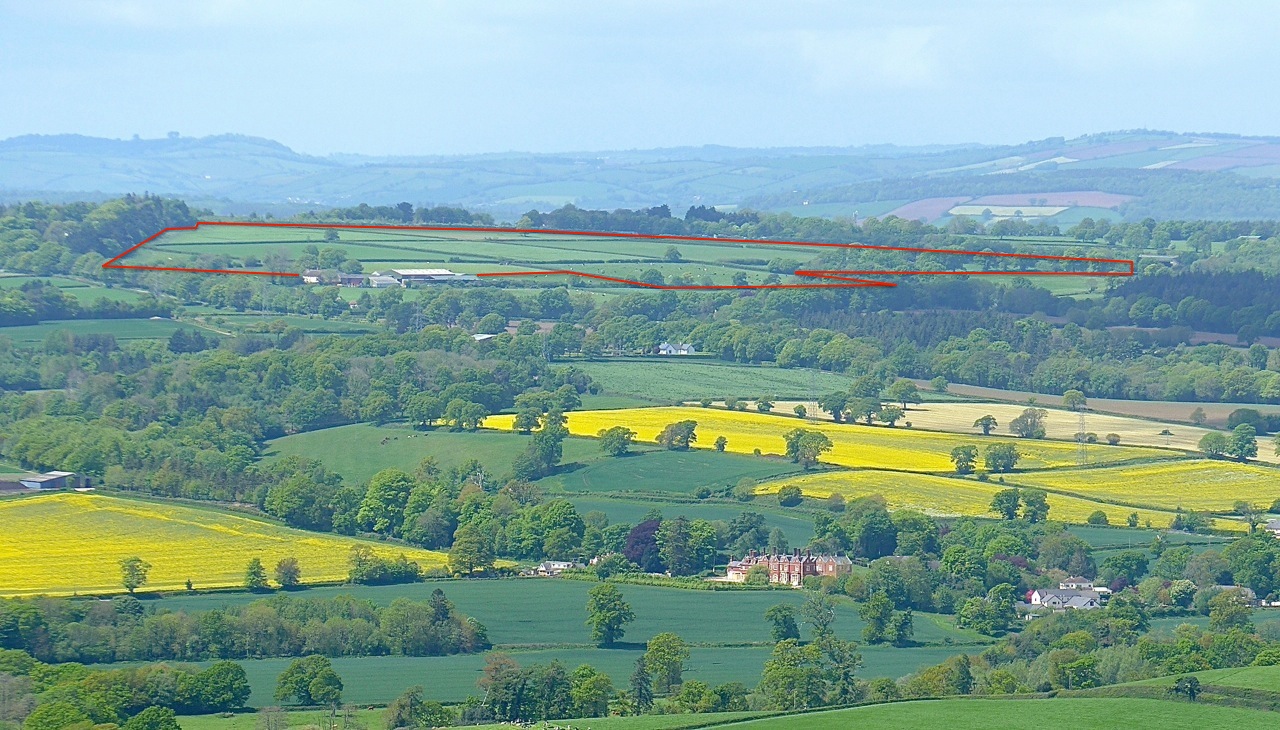
Fantastic news! Decades of unwavering local activism has finally won through.
Aggregate Industries' ludicrous plan to quarry Straitgate Farm in East Devon is dead, kaput, finito!

Today it has been confirmed that the company has abandoned its planning permission to quarry the site and has now sold the farm to the existing tenants.
A confirmation letter from Holcim UK to Devon County Council can be found here.
A press release from Straitgate Action Group can be found here.
We will continue to refer to the company here as Aggregate Industries – although it was rebadged earlier this year as Holcim UK, being a long-time subsidiary of the Swiss-based multinational – since that's the name so indelibly etched in the minds of local people, given the decades it has spent blighting their lives.
That blight has finally come to an end. Despite relentless attempts – over many, many years – Aggregate Industries has finally had to admit defeat. Its plans could not work.
By walking away from Straitgate, neither the company nor the County will run short of aggregate – for anyone at all concerned. In February this year, the company submitted an application to quarry 3.9 million tonnes of sand and gravel at Penslade as an extension to its Hillhead Quarry near Uffculme.
This monumental David vs Goliath victory – achieved against the deep pockets of the world's largest cement producer – stands as a testament to the power of local community action.

It means that the treasured landscape at Straitgate, with its network of ancient hedgerows and oak trees, habitat for dormice and bats, has been saved. Straitgate Farm, with its Grade II listed Devon longhouse, will remain a farm. The tenants, whose family has farmed the land for nearly 100 years, can continue to farm in peace. Nearby Cadhay has the assurance that the aquifer at Straitgate will remain undisturbed, so the water supply for the Grade I listed house, the Grade II listed gardens and mediaeval fishponds, and the wetland habitats in the ancient woodlands of Cadhay Bog and Cadhay Wood, will now be secure going forward.
 |
 |
All the many other people in the area wholly reliant on springs and wells for their water supply can also breathe a sigh of relief. Any increased risk of flooding to Ottery St Mary from mineral working on the slopes above the town has been removed. Exeter Road will not have to contend with an extra 200 HGV movements per day and the dangers this would bring. Birdcage Lane will remain unchanged – a safe local amenity for its wide variety of users. There will be no risk of bird-attracting water bodies – like the ones at nearby Blackhill Quarry – being formed under the flight path of Exeter Airport.

There will be no eyesore from East Hill, part of the East Devon National Landscape. Our climate, environment, and roads will be better off to the tune of some 2.5 million HGV miles.
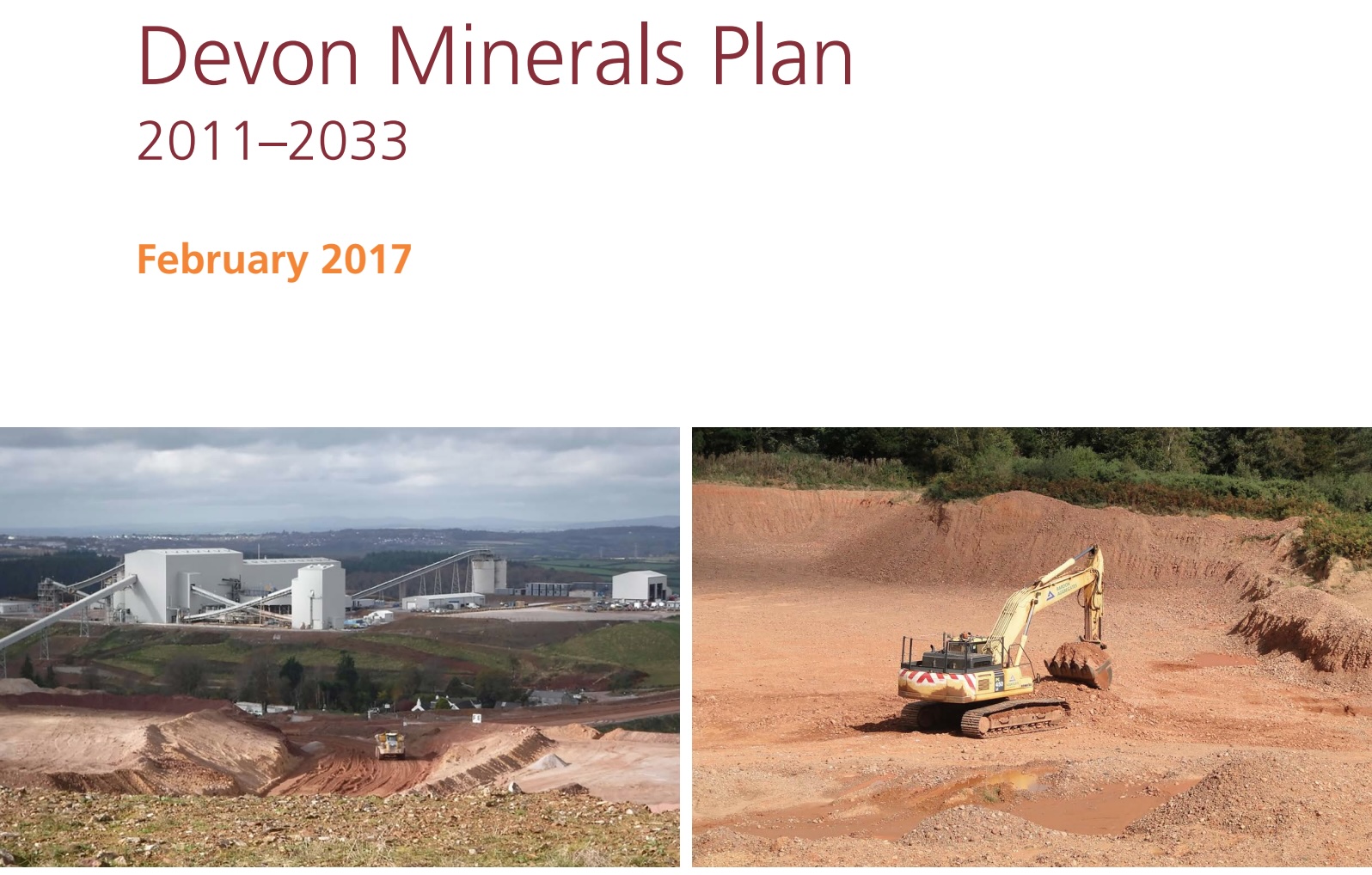
Thankfully, Straitgate will no longer risk looking anything like this:

This is a huge and embarrassing failure for Aggregate Industries. The company has squandered hundreds of thousands – if not millions – of pounds pushing a venture that was not only unsustainable, but clearly uneconomic and fraught with problems.
Aggregate Industries' pursuit of Straitgate has loomed over our community for decades – blighting lives, scuppering house sales, causing untold stress, anguish and expense. The company has shown it couldn’t care less. There’s little evidence to back Aggregate Industries’ claim of being:
A company that is intrinsically sustainable - trusted and respected by stakeholders and the communities in which we operate.
Stopping a quarry at Straitgate has been an exceptionally long struggle – perhaps one of the longest-running community campaigns against a development in Britain.
Straitgate Farm is situated in East Devon in the Otter Valley, close to Ottery St Mary, a beautiful market town steeped in history and tradition, famed for its fiery tar barrel tradition, its magnificent church, and its ties to the celebrated poet Samuel Taylor Coleridge. The town lies along the winding River Otter, where England’s first wild breeding beaver population in over 400 years was discovered. Straitgate Farm lies on the B3174 Exeter Road, a key route connecting Ottery St Mary to Exeter. It is part of a region characterised by rolling hills, farmland, and natural beauty. Records of Straitgate Farm date back to at least the sixteenth century.

 |
 |
The first planning application to quarry Straitgate Farm was submitted in 1967 by English China Clays, a predecessor company.

A public inquiry followed, attracting representations from many local people and organisations, including Oliver William-Powlett from Cadhay, Ottery St Mary Urban District Council, and the West Hill Ratepayers Association. Permission was refused on the grounds of risk to groundwater and prematurity.

We first became involved in March 2000, joining with other local residents opposed to Aggregate Industries’ push for the continued inclusion of Straitgate in the Minerals Local Plan. A key meeting was held at Cadhay in November 2001, in readiness for a public inquiry the following year. The name Straitgate Action Group was coined by a local journalist, and it stuck.

The group’s subsequent campaign was successful, and in 2003 Straitgate was knocked out of the Plan.
In 2010, when preparations started for a new Minerals Plan, Aggregate Industries again pushed for the inclusion of Straitgate. The company claimed some 8 million tonnes of sand and gravel were available at the site, giving any quarry an estimated lifetime of "approximately 20-25 years based on 350,000 tonnes/year".
In 2012, well-attended meetings at West Hill Village Hall and Ottery St Mary Football Club conveyed the community’s deep concerns to Devon County Council.

In the same year, we started A blog for Straitgate, never imagining that 13 years and 1,800 posts later we’d still be going, with enough material to fill a book.
Delays and expensive site investigations by the company were to follow. In 2013, ecological surveys found protected species, including at least eleven species of bats, and dormice.

In 2014, archaeological investigations found extensive evidence of Iron Age and Roman settlements.

Monitoring of the groundwater, which had started in 2013 with the drilling of 11 new boreholes, showed how sensitive surrounding springs, wells and streams would be to any mineral extraction, and, as a result of groundwater levels, how little material there would in reality be available to the company. For a whole year, the company wouldn't come clean on the fact that the depth of material that would remain unquarried above the maximum water table, to protect surrounding water supplies, was set to be zero – unlike elsewhere, and its recent application for Penslade where "the base of mineral extraction has been set at 1m above maximum recorded groundwater levels".
However, following another public inquiry, the company was this time successful. Straitgate Farm was formally adopted in 2017 as a Preferred Area for sand and gravel extraction in the Devon Minerals Plan – but, downgraded from the proposed Specific Site designation, and, crucially, for a much reduced figure of "up to 1.2 million tonnes from extraction above the protected water table".
Aggregate Industries’ first application to quarry Straitgate was submitted in 2015. Even then its plans were unsustainable, with the intention being to process material 8 miles away at Blackhill Quarry. A spokesman said the application was "the culmination of three years of careful planning...", but nine months later the company was forced to withdraw the application after it became clear it did not have the necessary rights over third-party land to implement its site access plans, and that permission to continue processing at Blackhill, on the protected Pebblebed Heaths, would not be forthcoming. The latter was a victory in itself for those of us wanting to see an end to Aggregate Industries' industrialisation of Woodbury Common in the East Devon AONB, and all the associated HGV traffic.

With the application to quarry Straitgate Farm delayed, the company made a planning application to import a limited amount of material into Blackhill for processing before the quarry’s closure. Permission was granted but never implemented, and mobile plant was subsequently installed at Hillhead, later to be replaced with the plant from Blackhill.
In 2017, the company submitted a revised application for Straitgate, with the proposed site entrance in a new location, and the material to be processed at Hillhead near Uffculme, a staggering 23 miles away from Straitgate, an option that the company had previously dismissed:

Over all the years of following this debacle, we've not come across anything similar - where 23 miles of public roads separate quarry face and processing plant, where 46 miles is clocked up before the product is even sold. And why would we? Profit margins on sand and gravel normally restrict the supply radius to 30 miles or so.
Both applications drew a huge public backlash, and hundreds of objections were lodged with Devon County Council. Scrutiny of the company’s plans in relation to the Straitgate site revealed a multitude of substantive issues, including the cattle crossing conundrum.

Whether due to the nature of these issues or the company's ineptness, or both, an inordinate period of almost five years followed, while Aggregate Industries floundered searching for solutions. During that time, it drilled 7 more boreholes for additional groundwater monitoring, and secured a separate permission for a livestock crossing to enable the cows to access alternative pasture – a permission since expired.
Also during those five years, Professor Brassington – a leading expert in hydrogeology – warned that any quarrying at Straitgate would irreversibly damage water sources. It became clear that the company was relying on an unorthodox seasonal working scheme – for a site where groundwater levels can rise 1m in 5 days – to extract down to a guesstimate of the maximum water table, a guesstimate subsequently proven to be wrong multiple times in multiple locations, in one location by 2.8 metres. Some areas would be underwater, even the loading area. In other areas, there would be no recoverable resource at all.

At the end of that period, serious issues remained unresolved. For instance, there were still key uncertainties with hydrogeology and drainage, because Aggregate Industries had failed to undertake the necessary additional testing.
On 1 December 2021, the Straitgate application finally came before Devon County Council's planning committee. Despite being recommended for approval by planning officers – the application was refused, following powerful representations from members of the public, experts, councillors and the group. As our planning lawyer, Tim Taylor, told the committee:
this application... is littered with inconsistencies, inaccuracies, and erroneous and/or missing information. Put simply, it is a botched application by the applicant and reads like one.
There were seven clear reasons for refusal, namely harm to the setting of heritage assets, potential harm to private water supplies, lack of a safe and suitable access in relation to the proposed cattle crossing and bus stop provision for school children, insufficient up-to-date wildlife survey information, an insufficiently detailed surface water management plan, unacceptable loss of mature trees and hedgerows, and the unsustainable distance between the proposed quarry and processing location.

However, Aggregate Industries thought it knew better and appealed the decision. In October 2022, a costly public inquiry ensued – costly not only for Aggregate Industries and Devon County Council, but also for the local people who supported the group, which hired a barrister from Landmark Chambers and participated as a Rule 6 Party. What sort of costs? Last year, for example, Gloucestershire mineral operator Cullimore Group reported that its appeal costs for an undefended day-long hearing were nearly £200,000. By contrast, Devon County Council defended all seven reasons for refusal, and, for two weeks, three barristers fought it out in front of two Planning Inspectors.
Representations were again made by members of the public, councillors and the group. A multitude of expert witnesses were called, including a number representing the group. Aggregate Industries was so concerned about Professor Brassington's arguments that it wheeled out not one but two hydrogeology experts. It should have saved itself – and the rest of us – the bother.
Whilst the Planning Inspectors granted the company permission on 5 January 2023 – to the surprise of many, and no doubt the company too – some viewed Aggregate Industries' victory as pyrrhic.

To make the development acceptable in planning terms and to mitigate the risks exposed during years of scrutiny, the Inspectors imposed 53 conditions – some pre-commencement, and many onerous. On top of these, the company was left with just "1.06 million tonnes of saleable aggregate" located 23 miles away from the processing plant, with the added cost of HVO fuel mandated for excavation and haulage.
One condition – to reduce the risk of bird strike to overflying aircraft – even stipulated:
25. No water body shall be created within the site other than the approved weigh bridge lagoon.
Why might that have been challenging? Not only has every sand and gravel quarry we've seen in Devon included water bodies, but Aggregate Industries’ flood mitigation and restoration plans for Straitgate also positively encouraged their creation.

But, given the constraints of the site and the need for so many restrictive conditions, why was the appeal ever allowed? Richard Kimblin KC, who represented Aggregate Industries at the Inquiry, clearly thought he had a theory when, in the same year, he gave a presentation about Straitgate and five other sites in "Legal update - The perils of minerals decisions and how to avoid them". Presenting to the Minerals Planning Conference, he alluded to a pattern in these six sites: appeals were typically allowed where a site was allocated in a Minerals Local Plan, AND if there were no policies of restraint – in other words, if the site was neither in the Green Belt, nor in an AONB. Unfortunately, Straitgate ticked both boxes, as did Craig yr Hesg, and in both cases their appeals were allowed. Fortunately for Chard Junction, Ware Park, Hatfield and Lea Castle, all had policies of restraint and their appeals were dismissed.

Once the appeal was allowed, the company could still have walked away – having seen the mountain of onerous conditions imposed by the Planning Inspectors. But no. After a further 12 months, apparently thinking about the way forward, Aggregate Industries' executive committee sanctioned additional spend for the next stage, to cover expensive water monitoring schemes, as well as a raft of other work. In poker terms, the company was going all-in.

However, just a few months later, in April 2024, the economic writing was on the wall. Aggregate Industries indicated that, unless conditions improved, the Straitgate project would need to be mothballed. It was not surprising. Whilst Aggregate Industries argued at the Public Inquiry that the need for minerals from the site was "urgent", events on the ground indicated otherwise. Just a few miles away from where the Straitgate material would be processed, Heidelberg Materials was mothballing its own sand and gravel operation citing economic issues; at the time of writing, the operation is still closed. It now also transpires that in 2023, sand and gravel sales in Devon slumped to their lowest on record, down by 29% on the previous year. By delaying for so long, Aggregate Industries had seemingly missed its window of opportunity.
When questioned further on the issue, all Aggregate Industries would say is:
... we have 10 years from the date of commencement to extract the mineral and that remains our intention.
As we posted at the time:
If the company has backed itself into an uneconomic corner, it has no-one but itself to blame; no-one forced the company to process the Straitgate material 23 miles away – a 46-mile round trip for every load of as-dug material, material that includes a 20% waste factor – or to work the site and haul material using expensive HVO fuel. It came up with those ideas all by itself.
Notably, for its new application to quarry Penslade, the company has not proposed the use of HVO fuel, and haulage from the quarry face to the processing plant is along a short internal track, not 23 miles along the A30 and M5.
But we had been questioning the viability of Straitgate for years – even before this post in 2012 – pointing to the fact that the company now had access to little more than 5% of the material first thought possible, and asking What is AI’s bottom line, because it surely can’t be profit? We even created a viability label.
It will now come as little surprise to local people to learn that the company – with its army of consultants and lawyers – has not managed to meet its pre-commencement conditions.
Aggregate Industries has therefore spent the last 10 years – 25 years if you include its efforts to secure the site’s inclusion in Minerals Plans – almost 60 years if you go back to when the farm was bought for aggregates by English China Clays in 1965 for £125,000, equivalent to £3 million in today’s money – on a futile quest, from what was once thought to be 20 million tonnes down to effectively zero.
We previously explained the debacle using the analogy You have two cows. This now needs amending:
Aggregate Industries: You have two cows. You lose them both.
What's a typical length of time for a minerals application? In it’s latest Annual Mineral Planning Survey Report, the Mineral Products Association wrote that in 2023 for sand and gravel:
the average time taken to determine a mineral planning application (pre-application through to a permission being issued) was 22.6 months
But it can sometimes take longer. When Lafarge abandoned its quarry proposal on the Isle of Harris after a battle lasting 13 years, it donated €50,000 for local sporting facilities as a gesture of goodwill, but even then the Western Isles Council's environmental chairman was scathing:
For the future of an area to hang in the balance for 13 long years, with the consequent disincentive to other potential businesses, is, frankly, nothing short of a disgrace.
So, if 13 years is nothing short of a disgrace, how about 25 years?
Goodness knows how much money in total Aggregate Industries and its Zurich bean-counters have flushed down the toilet – instead of a gravel pit, Straitgate Farm has turned into a money pit.
The company should have heeded our advice in 2015, when we warned about the sunk cost fallacy:
It’s time for Holcim's bean-counters to tell AI to stop throwing good money after bad and leave the farmers to get on with farming the land...
Perhaps it should study this comic strip from Doist:

Questions need to be asked:
Why did Aggregate Industries continue to champion such a site knowing the constraints, knowing the relatively small amount of sand and gravel now available, knowing the considerable haulage distances that would be required for processing?
When permission was eventually refused nearly seven years after submitting its first planning application, almost five years after the second, why did Aggregate Industries go to the considerable expense of appealing the decision, knowing how constrained and uneconomic the whole scheme was?
Why did Aggregate Industries not listen to the local community, take heed of local knowledge, or work with local stakeholders?
When exactly did Aggregate Industries realise it couldn’t fulfil the pre-commencement planning conditions or make the numbers stack up? Has the company blighted lives longer than necessary?
Of course, we don’t expect any answers. Openness and transparency does not come easily to Aggregate Industries.

So, where did it all go wrong for Aggregate Industries? With millions of tonnes of material initially on offer, and with the advantage of a Preferred Area designation in the Minerals Local Plan, and with no irritating policies of restraint to hinder things, and with the great weight that national planning policy affords to mineral extraction, and with an army of expensive lawyers and environmental consultants working on its behalf, and with no objections from the Environment Agency or other key statutory consultees, and with relatively few pesky residents living around the site, how on earth did the company manage to squander such a promising opportunity?
Clearly, it looks like a case of corporate incompetence – a textbook example of how not to go about seeking permission to open a quarry. Aggregate Industries made one mistake after another.

As we wrote at the time:
If every minerals-related planning application went as disastrously as the one Aggregate Industries has spent the last 6 YEARS pursuing at Straitgate Farm, there would be no minerals industry.
Not only was there seemingly little consideration of viability, but there were also so many falsehoods that we created a label for them on this blog. By the end, the company still hadn't solved the cattle crossing issue. It still hadn’t properly measured infiltration rates, or produced a reliable surface water management plan. It still hadn't even been able to produce workable plans for the site entrance – not even for the third of its options put forward for the site, between the two TPO'd oak trees and the third-party hedgebank; another example of where it should have heeded our advice.
 |
 |
 |
Looking back, was there one overriding factor that saved Straitgate Farm? Was it the TPO on the Birdcage Lane oak trees? Was it the issues surrounding groundwater and private water supplies, and all the associated monitoring required? Was it the cost burden of the excessive haulage distance and the requirement to use HVO fuel? Was it the slump in sand and gravel sales? Was it the brave tenants, and their displaced cows that would need to cross the Exeter Road 4-times daily? Was it the doggedness of the local community? Or was it a combination of all those things and more?
Aggregate Industries has wasted everyone’s time and money – including Devon County Council’s – for minerals that were arguably not even needed. It’s reprehensible. As we have been saying for years, the plans for Straitgate should never have been pursued.
Who was ultimately responsible at Aggregate Industries? That’s hard to say. Since our involvement began in March 2000, the company has cycled through eight different CEOs – six in just the last 15 years. No one can accuse Aggregate Industries of letting the grass grow under its executives’ feet, but perhaps this corporate game of musical chairs contributed to a lack of clear-headed thinking about the strategic rights and wrongs of a new quarry in East Devon on a site with so many constraints. Answers on a postcard.

So, no thanks at all to Aggregate Industries, now masquerading as Holcim UK. But we would like to put on record our heartfelt thanks to the countless local people who have supported us over this long and arduous journey with help, encouragement, advice and funding, to all those who sent in responses to consultations, or who spoke at inquiries and committee meetings, to local County Councillors Claire Wright and Jess Bailey, to Ottery Town Council, West Hill Parish Council, to planning consultant Charlie Hopkins and planning lawyer Tim Taylor, and all the other many and various experts. In particular, we’d like to thank Roger Giles, Rupert Thistlethwayte, Brian Taylor, Laura Horner, Chris Wakefield, and Robert Pooley, who have been involved from the start, and some very courageous farm tenants who have faced down countless eviction attempts.
Without all this steadfast support we have no doubt that things would have turned out very differently.
Thank you 🙏🙏
Having lived with the threat for 25 years or more, everyone in and around Straitgate Farm will now be able to live their lives in peace. This marks an end to the company’s quarrying activities in East Devon, which can be traced back to the 1930s.
The battle over Straitgate exposes the tension between resource extraction and the preservation of rural Britain, between multinational mineral giants and small local communities. We hope our success – albeit a long time in arriving – will serve as a beacon of hope for other communities facing similar challenges.
Success is not final, failure is not fatal: it is the courage to continue that counts – Churchill
You may never know what results come from your actions. But if you do nothing, there will be no result – Gandhi
Illegitimi non carborundum – Don't let the bastards grind you down
Mark & Monica Mortimer