Unsaturated zone flow times of 8 YEARS – not the 1 to 3 days consultants claimed...
Drinking water sources suffering PERMANENT acidity increases – due to the LOSS OF 7 YEARS of rock/water interaction times, a 50% CUT...
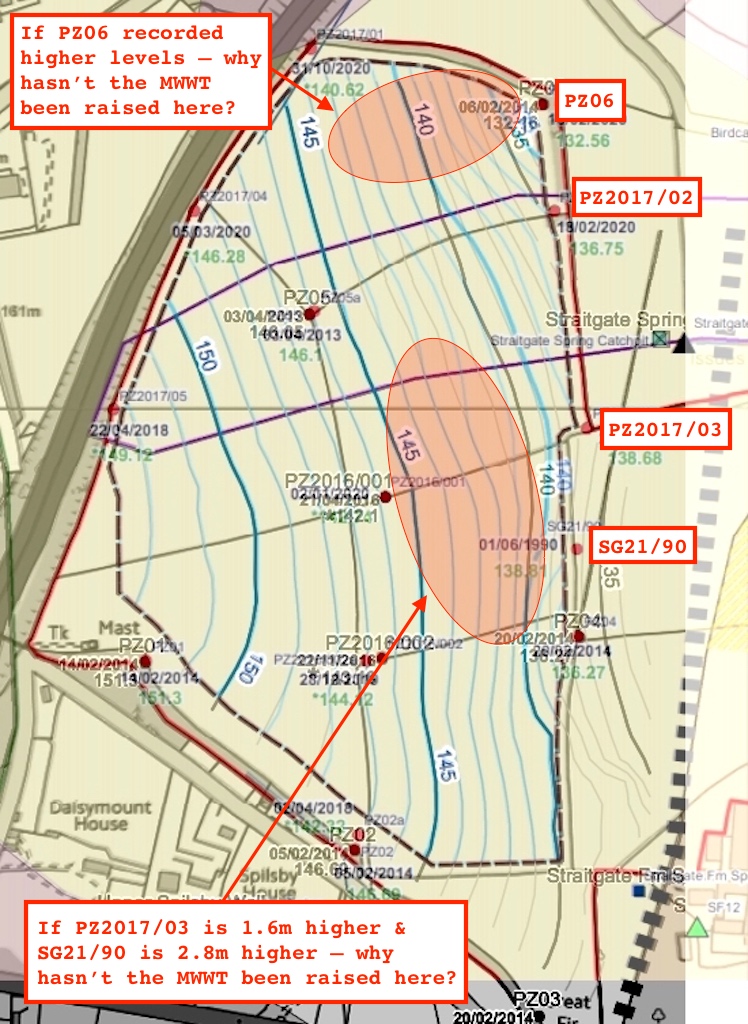
Piezometers recording lower groundwater levels than reality – enabling extraction DEEPER THAN THE MAXIMUM WATER TABLE...
These are some of the damning conclusions from a
new report by Professor Rick Brassington in response to Aggregate Industries’ planning application to quarry Straitgate Farm.
If your report raises any new issues which the EA consider to be material then I will ask the applicant to clarify.
However, clearly the report does raise new material issues, which will need much more than clarification to sort out. This would have become immediately apparent if the Council had bothered to read it.
Because, what’s abundantly clear from Prof Brassington’s report is that Aggregate Industries’ so-called hydrogeology experts – Amec Foster Wheeler now Wood – have not been very expert at all. They have either been guilty of intentionally misleading, or have completely misunderstood groundwater behaviour at Straitgate, such as the length of time water takes to permeate down to the aquifer. Either intentionally or otherwise, they have dismissed the role that the unsaturated zone – the resource above the water table that Aggregate Industries wants to quarry – plays in determining the groundwater chemistry.
Prof Brassington warns:
the application for the proposed quarry should be refused because of the irreversible damage that it will cause to the local groundwater system that both supports local habitats and forms the water supplies for Cadhay House with its medieval fishponds and tearooms, more than 100 people plus three livestock farms. 80
By the way, Prof Brassington is not just any expert on hydrogeology; that's obvious from his CV which stretches across pages 32 to 40 of the new report. He clearly has more experience, knowledge and independence than any consultants engaged by Aggregate Industries, a company hell-bent on extracting as much material as possible. He is a recognised authority on hydrogeology, recent
winner of the Whitaker Medal, and
author of various textbooks on the subject.
This time, Prof Brassington focuses on the permanent change to groundwater chemistry that would result if all but 1m of the unsaturated zone were removed.
The moderately low pH, alkalinity and dissolved solids in groundwater in this area is, therefore, not necessarily a function of the time it takes for water to pass through the unsaturated zone, but a function of the variable and limited presence of soluble material within the sub-surface materials. A reduction of the unsaturated zone therefore will not necessarily give rise to a reduction in the pH, alkalinity or dissolved solids concentration of groundwater. With respect to the topsoil, subsoil and overburden that will be replaced once extraction of an area is completed, the replaced material will then be subject to water/rock interaction processes as water percolates through the replaced unsaturated zone material. As is shown by the leach test data, the soluble content of the unsaturated zone is low across much of the site or is mostly influenced by the shallow deposits which will be replaced after mineral extraction. Therefore, again, this implies that removal of the deeper unsaturated material will not necessarily result in a noticeable change in groundwater quality beneath the site or, more categorically, not at downgradient receptor. p10
Prof Brassington, however, is having none of that:
The length of the travel time involved is critical in determining the development of the chemistry of the water that discharges from the springs. 35
Let’s repeat that for the benefit of those championing Aggregate Industries’ scheme – be they consultants, the EA or Devon County Council – who seem so hard of understanding:
The length of the travel time involved is critical in determining the development of the chemistry of the water that discharges from the springs. 35
In fact:
...the whole of the flow path from the ground surface where recharge water starts its journey downwards through the unsaturated zone to the water table where it becomes groundwater which then flows through the saturated zone to emerge at the springs is essential in the development of the water chemistry. The removal of part of the unsaturated zone where flow velocities are far less than in the saturated zone will result in the greatest impact on the water chemistry. 21
It makes you wonder how knowledgeable Aggregate Industries’ experts really are. Or indeed, the EA for being taken in by their tales.
transit of water through the unsaturated zone is considered to be fairly rapid due to the intergrannular and fractured nature of the BSPB and therefore the thickness of the unsaturated zone may not be as important. 2.5
...recharge reaches the water table in the BSPB through unsaturated thicknesses of between approximately 3 and 10 m within between 1 and 3 days. This is consistent with the conceptual model for relatively rapid recharge occurring in the BSPB (i.e. days rather than weeks or months). 2.7.3
This is rubbished by Prof Brassington, who reminds Wood’s so-called experts that groundwater flow through the unsaturated zone occurs as a "piston flow resulting in an equal volume of water entering at the top of the unsaturated zone being released from the bottom to enter the saturated zone beneath the water table" and that:
It is important not to confuse this type of flow with one that suggests that the recharge from any rainfall event reaches the water table rapidly through fracture flow 60
Prof Brassington says the time groundwater takes to travel through the unsaturated zone should not be measured in days, weeks or months – but in YEARS:
According to Wang et al (2012) the unsaturated zone velocity for the Sherwood Sandstone Group falls in the range 0.6 – 2.3 m/year with a mean of 1.06 m/year (these values were summarized by Chilton and Foster (1991)). The values for unsaturated zone flow rates are several orders of magnitude (three to five) lower than flow velocities in the saturated zone. 59
In the case of Straitgate:
... the lack of cement means that the rock is basically a pebbly sand with layers of silt and clay; consequently there are no fractures and so there will be no bypass flows. 59
It is simple to calculate the loss in groundwater travel time caused by the loss of some 7 m of the unsaturated zone as it is 7 × 1.06 years = 7.42 years. 62
YEARS, NOT DAYS. Much as indicated below – and widely elsewhere:
That’s an amazing, fundamental mistake for Amec to have made, and for the EA to have overlooked. It makes you wonder how many other things these parties have got wrong about Straitgate's groundwater.
Removing much of the unsaturated zone – and its capacity to store large amounts of slowly moving water – will naturally have huge impacts on spring flows and flood risk. It is however the change in groundwater chemistry that Prof Brassington has focused on. Indeed, in his
original report a year ago he warned:
…the proposals will cause a large reduction in the thickness of the unsaturated zone that will reduce the time for the recharge to percolate through this zone. This reduced period will mean less time for rock/water interaction and will result in a less chemically mature groundwater that is more acidic than it is at the moment. These are reasons why the application should be refused by Devon County Council. 5.13
Given the EA’s dismissive attitude – Prof Brassington has raised those warnings again in his new report:
The water chemistry develops as the water percolates through the unsaturated zone and then, once it has reached the water table, it flows through the aquifer. A series of rock/water interactions takes place along this flow path causing the chemistry of the water to change as it moves along. These interactions are slow and so the time taken for the water to reach the springs will determine the concentration of the dissolved minerals, the balance between the dissolved minerals, the pH and the electrical conductivity of the water. 35
Prof Brassington shows that for Cadhay the period for rock/water interactions would be HALVED if Aggregate Industries’ proposal went ahead:
The EA calculated the Source Protection zone (Walford, 2013) using a similar method to the one adopted here. The map they have produced is shown below in Figure 11. The distance of the flow path from the recharge area in the proposed quarry to the Cadhay spring has been marked on the map. 64
Calculations of the time that groundwater takes from rainfall percolating into the ground to the groundwater emerging from a spring have been carried out for the Cadhay spring that supplies Cadhay House and estate. The water takes almost 15 years to make this journey and if all but 1 m of the unsaturated zone is removed this reduces some 50% of the total travel time. 76
It shows that the time taken can be expected to be sufficiently long for the quarrying to have been completed by some years by the time that the water quality changes have occurred. This will provide scope for AI to deny causing the problem. 77
Prof Brassington warns:
The impact on the travel time also means that the deterioration of the groundwater chemistry will be a permanent change and it will not be possible to reverse it. 77
The concern for the 100 people or so who obtain their water supply from these springs is that the water make up will substantially change and a reduction in the pH will mean that the water is too acidic for drinking without treatment and it will dissolve metal pipework and storage tanks. It will affect the chemistry of the water in the streams that will impact on the Cadhay Bog and Cadhay Wood wetland habitats in the ancient woodland as these depend on the stream flows. 56
In his new report, Prof Brassington is again at pains to remind us – or at least remind Aggregate Industries’ consultants and the EA who should know about these things: "the depth of a borehole and its location within an aquifer have a significant influence on the water level within it":
The use of fully penetrating piezometers to monitor the elevation of the water table as is the case at the Straitgate Farm site, means that it can be expected that the water levels in the piezometers will reflect a lower water level than the correct water table due to the three-dimensional aspect of groundwater flow. The MWWT grid will therefore be modelled from levels lower than reality, which will enable AI to excavate below the maximum water table. 73
Quite how this planning application can go any further forward – as it currently stands – with so many errors in the environmental information, and with so many warnings from such an eminent independent expert in hydrogeology, is anybody’s guess. An invasive sand and gravel quarry at Straitgate Farm, is – as Prof Brassington so clearly points out – no way to treat "a fragile groundwater system" and no way to treat a water source depended on by so many, including an important Grade I listed house and gardens.