Showing posts with label Natural England. Show all posts

Friday, 6 August 2021

More overburden storage problems

According to Aggregate Industries, 159,000 cubic metres of overburden material from above the sand and gravel resource would need to be stored elsewhere on site in 5m high mounds if Straitgate Farm were to be quarried, material that would in time need to be restored. 

The issue of soil storage is important. The Devon Minerals Plan states "a proposal affecting the best and most versatile land should provide for the restoration of the land to its former quality." Natural England had asked for more information on the storage of subsoils, information that was not supplied

The different categories of retained soils must be stored like-on-like. Overburden can only be stored on overburden. Topsoils and subsoils S1 and S2 would first need to be removed from those storage areas, and stored elsewhere. At the same time, in line with proposed conditions from the Environment Agency, "no working shall be undertaken below the ‘Maximum Winter Water Table (MWWT) grid’" or "closer to the contemporaneous measured groundwater level than 1m." 

We have recently posted that – in the middle of summer – a new spring was discovered exactly where Aggregate Industries wants to stockpile 82,000 cubic metres of overburden in the area designated OB1. The new spring is close to the borehole location SG21/90 where groundwater was recorded just 1.26m below the ground surface in June 1990. 


However, there’s clearly a further problem. The geological plan shows groundwater close to the surface in the other area designated for overburden storage, OB2, where Aggregate Industries wants to stockpile another 77,000 cubic metres of overburden. Borehole SG12/90 recorded groundwater at 1.59m below the surface – again in the middle of summer, in June 1990. 

The EA has stipulated that these 1990 groundwater levels should inform the application

There is clearly an unmistakable pattern beyond the eastern boundary of the extraction area, along the geological fault line, exactly where Aggregate Industries wants to store overburden. 


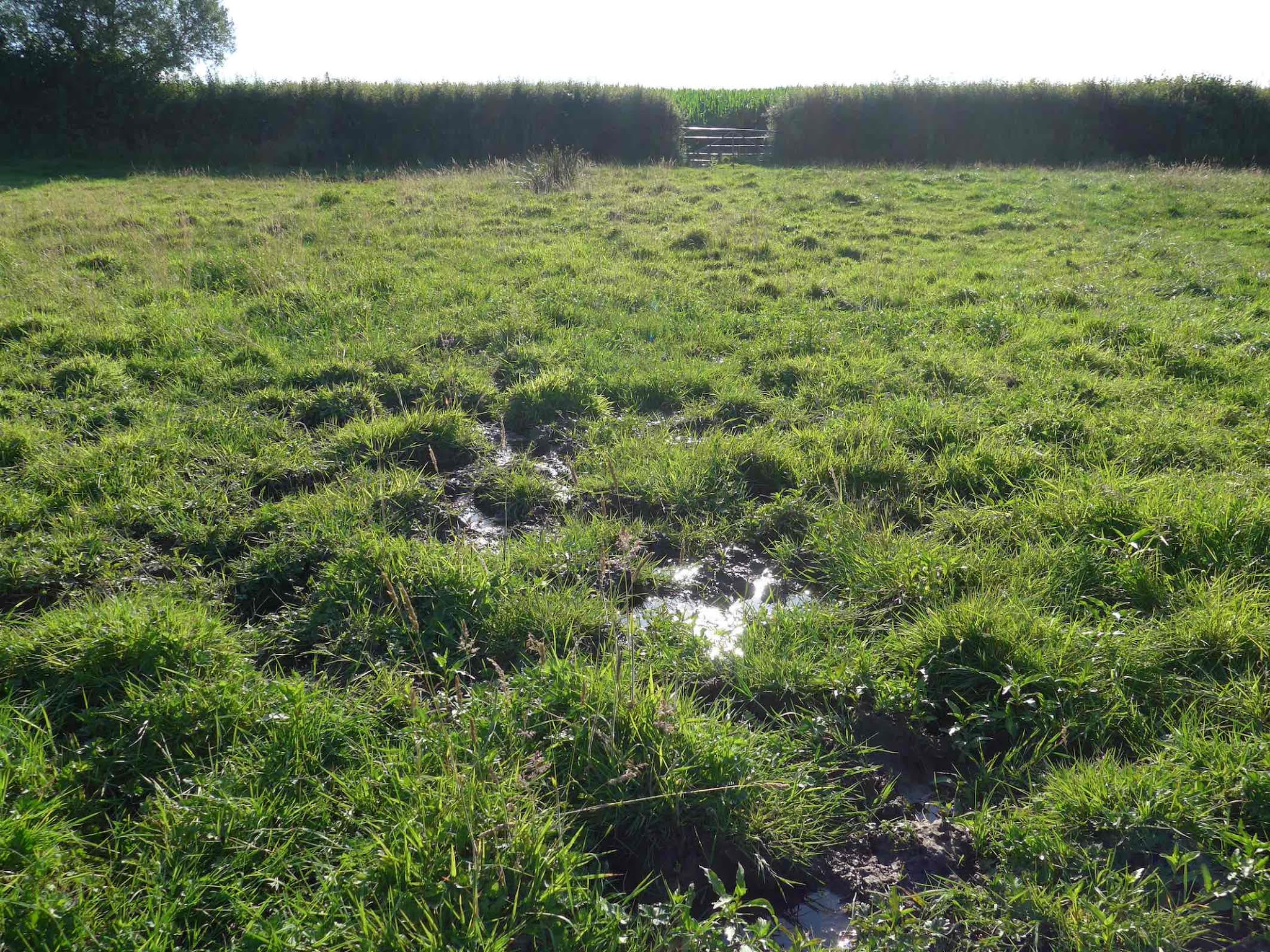
This is a photograph of another spring, issuing to the north of the planning red line boundary as indicated at the top of the above plan, taken just last week. 


So, where could overburden be stored where the removal of topsoils plus subsoils would not breach the maximum water table, where groundwater would be at least 1m below any working? Given that no groundwater monitoring has been carried out in the proposed overburden storage areas, no one knows.

Tuesday, 13 July 2021

New spring found at Straitgate Farm – with big overburden consequences

This month – in the middle of summer – a new spring was discovered beyond the proposed extraction area, close to the fault indicated on the geological plan. What is the problem with that? The spring is exactly where Aggregate Industries wants to stockpile 82,000 cubic metres of overburden, as indicated on the phase 1 plan. Here is an overlay of those two plans:
 

It shouldn't be a surprise. The new spring is close to the borehole location SG21/90. The maximum water table contours – the MWWT, the contours that would dictate the base of any quarry at Straitgate Farm – have recently been revised to include the groundwater level recorded at SG21/90, where groundwater was recorded just 1.26m below the ground surface in June 1990

In addition, back in 2018, we informed the Environment Agency of a long-standing spring that feeds the Cadhay Wood Stream – marked X below – that had not previously been identified by consultants.
 

The EA responded: 
The presence of the spring emergence point up-gradient of Cadhay Wood Stream does not indicate that groundwater discharging into the stream originates from a wider area than previously understood.
The new spring – directly to the west of the X – feeds into the same watercourse. Where does this water go? Cadhay’s listed mediaeval fishponds. 

What are the overburden consequences? Before any overburden can be stored in that area, top soil and subsoils (including an as yet unspecified thickness of subsoil S2) must first be stripped – because soils must be stored like on like; overburden can only be stored on overburden
AREA OB1 DESIGNATED FOR THE TEMPORARY STORAGE OF OVERBURDEN. FOOTPRINT AREA = 23,400 SQ.M TO BE STRIPPED OF TOPSOIL (0.3M) AND SUBSOIL (0.25M) IN ADVANCE, WITH MATERIALS SEPARATELY STOCKPILED INTO APPROPRIATE NEAREST DESIGNATED STORAGE AREA. POTENTIAL OVERBURDEN STORAGE CAPACITY OF 82,000 CU.M ... 
And the problem with that? In an effort to protect groundwater, the EA has conditioned that no working shall be undertaken below the maximum water table. Plainly, if water is issuing from the ground in July, then groundwater is too close to the surface for digging to be permitted in this area. 

So, where could overburden be stored? Where could the removal of top soils plus subsoils not breach the maximum water table? No one knows. No groundwater monitoring has been carried out in the proposed overburden storage areas. 

Aggregate Industries’ soil storage plans have already run into problems with Natural England. This is another mess.
 

Monday, 5 July 2021

AI fails to answer Natural England’s BMV & subsoil concerns – and gets soil storage numbers completely wrong

We recently posted that Aggregate Industries – in its "final response" – had refused to supply cross sections to Devon County Council's Flood Risk Management Team in its role as Lead Local Flood Authority, to show how the infiltration areas intended to prevent downstream flooding could be accommodated within the extraction area. 

In the same final response, Aggregate Industries has also failed to answer Natural England's concerns on how the soils would be restored back to best and most versatile agricultural land, particularly how the two subsoil resources would be stored and restored. Soil volume numbers are also completely wrong.

The Soils Report provided by Aggregate Industries states: 
Two subsoil resources have been identified, one heavy loam and one clay. 

Subsoil S1 

4.4 Although there is some variation in texture across the site, the upper layer of subsoil is medium to heavy textured and can be considered as a single resource. It is easily damaged by mishandling and should be stripped when as dry as possible down to the easily distinguished clay or the gravel layers which are below it. The thickness of the this [sic] resource is variable, and in some localities extends below 1.2 m depth, but the mean thickness is approximately 250 mm...  

Subsoil S2 

4.5 This comprises the dense clayey or heavy clay loam lower subsoil which is a poorer resource easily damaged by mishandling. Its thickness cannot be estimated from an auger survey. 
The Soils Management Scheme document, again provided by Aggregate Industries, states:
...although the topsoil was a single unit across the application site, the subsoil was split into two types, broadly relating to the different ALC gradings: subsoil type 1 coincided with Grade 2; subsoil type 2 coincided with Grade 3b; whilst Grade 3a had both subsoil types.

All topsoil and the two subsoil (upper and lower) units will be stripped and stored separately to enable later reuse as part of final restoration. 
In its final response, Aggregate Industries says the following soil quantities would be generated: 
Grade 2 (3ha) – 9,000m3 of top soil [300mm] and 7,500m3 of sub soil [250mm] 
Grade 3a (14ha) – 42,000m3 of topsoil [300mm] and 35,000m3 of subsoil [250mm] 
Grade 3b (2ha) – 6,000m3 of topsoil [300mm] and 5,000m3 of subsoil [250mm] 
We have added the implied depth of material in brackets. 

But the numbers are nonsense. They IGNORE the topsoils that must be removed from subsoil storage areas, and they IGNORE the topsoil and subsoils that must be removed in overburden storage areas – because like must be stored on like. The Soils Management document says:  
3.3 Topsoil would be stripped in advance of subsoil mound construction and the topsoil and subsoil would be stripped in advance of overburden mound construction... 3.2 (to allow like-on-like materials to be placed on top of each other). 
How much additional soil would be generated from the storage areas? The drawing below gives a clue.

Furthermore, where are the details about subsoil S2 in Aggregate Industries' response? Subsoil S2 is found across the bulk of the site. The company's Soil Report says: 
4.9 To restore the land to agricultural best and most versatile quality will require a profile of at least 550 mm of topsoil and loamy subsoil placed over subsoil S2
The Soils Management Scheme report warns:
3.1 The main limitation to restoring the entire application site to best and most versatile quality will be the inherent characteristics of subsoil type 2
The degree to which the best and most versatile land should be capable of being reclaimed without loss of quality. 

Without this information, Natural England may need to object to the proposal. 

Please re-consult Natural England once this information has been obtained.
 

Amongst other things, the statutory consultee wanted to know about the two subsoil resources: 
Natural England note that two subsoil resources have been identified on the site... 

The Soil Management Scheme does not make it clear that the subsoils S1 and S2 will be stripped and stored separately and the plans submitted... detailing the onsite designated areas for the temporary storage of subsoil do not show the storage location of subsoils S1 and S2... Without the separate stripping and storage of the subsoil S1 and S2, the accurate detailing of their storage location, and the restoration as described in the ES Ch 14 above it is our advice that this would [compromise] the ability to achieve high standards of restoration and to restore the land to agricultural best and most versatile quality
So – given Natural England requested information on subsoils S1 and S2 – where is that information? If both are needed to restore the land back to BMV, why is there no mention of the two subsoil resources in the company's final response? Why is there no mention of how these two resources would be stored?

But Aggregate Industries doesn’t just fail there. The company claims: 
In respect of the maximum extent of disturbed land open for which storage capacity is required, this has been calculated as follows: 
Ancillary area – 8ha (top and sub soil stripped only) 
Phase 1 – 6ha (top soil, sub soil and overburden stripped) 
50% of Phase 2 – 5ha (top soil, sub soil and overburden stripped)
But it is plain to anyone who reads the Soils Management document – "3.2 All of the soil resources from Phase 3 will then be direct placed into the previously worked out void, as shown in Drawing SF / 5-3 Rev B" – and who looks at that drawing "SF / 5-3 REV B", that the above is not correct. The drawing shows all the phases in operation; phase 1 would not start to be restored until the beginning of phase 3: 
SOILS FROM PHASE 3 DIRECT PLACED ONTO PHASE 1 
In conclusion, "the maximum extent of disturbed land open for which storage capacity is required" would significantly exceed the area claimed in Aggregate Industries' final response. Additional capacity would be needed to accommodate all the different soil types from the extraction, ancillary and storage areas. Where would all that capacity be found?

Six years on from first submitting this planning application, Aggregate Industries still can't seem to get its head around soil management. 
 

Thursday, 20 May 2021

Without further information, ‘Natural England may need to object to the proposal’

Since submitting its first planning application to quarry Straitgate Farm back in 2015, Aggregate Industries has been granted 6 years by Devon County Council to resolve the various problems that have arisen.
 
And yet, there are still a multitude of substantive issues the company must resolve. Would it ever be able to resolve them? Are the complexities of Straitgate Farm simply beyond the capabilities of Aggregate Industries and its paid-up army of consultants? 

What hope is there to resolve the complicated issues, when it can’t even get the basics right? Take soils. 

Straitgate Farm comprises best and most versatile agricultural land. The Devon Minerals Plan says: 
The site should be restored to enable resumption of agricultural use. To ensure the site is restored to an appropriate grade of agricultural land quality, proposals should assess the Agricultural Land Classification and detail proposed soil management techniques should be used throughout the site working and restoration stages. The working and restoration phasing should minimise the area of land not in cultivation, as soil is best conserved by being farmed rather than stored where some deterioration may occur. 
Restoration back to BMV would obviously be a tall order, given that topsoils would be stored 3m deep for up to 12 years. The company's supporting statement claims "The long term after-use would be light intensity agricultural grazing." Land that could only support "light intensity agricultural grazing" is by definition not BMV. Soils suffer significant deterioration when stockpiled in piles more than 1m deep for long periods of time. They suffer rapid loss in organic carbon levels and soil organisms. Earthworms are key for soil quality but do not survive at depths greater than 1m. Soils stored in bunds become anaerobic within a few weeks. Soils stored for longer than a year suffer irreversible impacts. 

Natural England has now responded again to the application. It is the fifth time this statutory agency – the one charged with protecting our natural environment and the one now "cut to the bone" – has had to deal with the proposal – excluding the multitude of responses in relation to the site's inclusion in the Minerals Plan, and Aggregate Industries' in-tandem applications to import material to Blackhill and Hillhead. Previous Natural England responses for Straitgate can be found here, here, here and here

Natural England first warned Aggregate Industries about soils back in 2015: 
as the site is BMV, the same area of BMV land should be restored. If there is no topsoil in an area it cannot be returned to grade 3a. 
Details are needed on the restored profile. Para 3.42 refers to a restored profile of 1m, whereas the usual target profile would be 1.2m. The MAFF ALC survey shows that there are two distinct subsoils, which should be stripped and stored separately ready for replacement, however there is only reference to a single subsoil in the supporting documents.
Given the nature and extent of the comments and requirements from Natural England regarding soil storage it would be helpful if you could update the soils management strategy to include the comments made by NE. Additionally, I would wish AI to comment on the relationship between the NE requested condition that soils should not be stripped in the winter months, the ongoing farm management and soils storage methodology. 
A soils management report was duly produced – the one recently consulted on – claiming "no loss of best and most versatile land." It was a big claim, and a questionable one, particularly given all the material needed to buttress the A30

But nothing was written about soil movements during the winter, or – remembering the Mineral Plan's advice that "soil is best conserved by being farmed rather than stored" – how soil storage would work with ongoing farm management. Nothing was written about separately storing the "two distinct subsoils" that Natural England had referenced in 2015. 

So here we are, in 2021, with Aggregate Industries still not having worked out something as basic as how and where it will store all the soils. Is the company just incompetent? Natural England now says
As submitted, the application could have potential significant effects on soils. Natural England requires further information in order to determine the significance of these impacts and the scope for mitigation. The following information is required: • The degree to which the best and most versatile land should be capable of being reclaimed without loss of quality. Without this information, Natural England may need to object to the proposal. 
The Soil Management Scheme and the detailed area plans submitted do not clearly identify the origin, intermediate and final locations of soils for use in the restoration, as defined by soil units (topsoil T1 and subsoils S1 and S2), together with details balancing the quantities (demonstrating the site has storage capacity), depths, and areas involved. We would expect restored soil profile to resemble pre working soil profile … if the grade is to be maintained. 
...the Soils and Agricultural Land Classification Report (ES Ch 14) states that there is Grade 2, 3a and 3b soils present on site…. reports should detail how it is intended to restore an equivalent area of Grade 2 and 3a of the soils on site being disturbed by these proposed works, specifically with soil volumes and restoration profiles provided. 
Without the separate stripping and storage of the subsoil S1 and S2, the accurate detailing of their storage location, and the restoration as described in the ES Ch 14 above it is our advice that this would [compromise] the ability to achieve high standards of restoration and to restore the land to agricultural best and most versatile quality. 
Aggregate Industries has had so much time – more than enough time, most reasonable people would think – to sort these things out. What is the point of statutory consultees providing response after response if Aggregate Industries just ignores them?

Friday, 22 January 2021

Natural England ‘cut to the bone’ and unable to protect wildlife – say staff

Everyone knows we can’t do basic statutory stuff, let alone the bigger, exciting projects we want to do.
The government’s conservation watchdog has been “cut to the bone”, with staff underpaid, undervalued and overworked and feeling unable to protect England’s most valuable wildlife sites, according to a new report and testimony from workers.
Mike Clancy, Prospect union general secretary, said there was a “yawning gap” between the government’s rhetoric on climate change and biodiversity, and the reality of years of underfunding environmental agencies.
“Protecting nature means investing in the people who do that work,” he said. “Natural England is at the heart of this agenda but it can only be effective if it is properly funded and the importance of its staff properly recognised.”

Tuesday, 28 January 2020

UK government’s “dirty secret”

The UK is leading action to tackle climate change, or so it claims:


COP26, the 26th United Nations Climate Change conference, will be held in Glasgow this year. As the Newsnight clip points out, "UK policies on climate change will be scrutinised like never before."


No part of government, and no part of the economy and society, could be left unaffected if the push towards net zero was to be successful, said [Jim Skea, professor of sustainable energy at Imperial College London]. “We really need to do it all,” he said. “Nothing can be wiped off the table. No sector can be left to not contribute – really, this needs contributions from absolutely everything.”
Which, of course, also includes our friends at Aggregate Industries, and parent LafargeHolcim.

Thursday, 1 August 2019

Natural England tells AI to make space for sand martins at Rockbeare


It concerned Aggregate Industries' application DCC/4132/2019, "to continue importation of inert soils and subsoil to allow for revised restoration contours at Marshbroadmoor including a revised restoration scheme at Rockbeare Quarry."

According to AI, "Biodiversity matters to us 🌍":


And indeed, through a wildlife focused #restoration scheme, AI might have been "well placed to make a positive contribution to UK #biodiversity" at Marshbroadmoor. Instead, AI planned to remove habitat for nesting sand martins currently resident at the site:
It is not considered safe or feasible to maintain or create a face suitable for nesting Sand Martins as part of the final restoration scheme.
We also note that Sand martins are recorded breeding on site but that post restoration the nest site will be lost. No compensation has been proposed for this loss and we would advise that consideration is given to revising the final site layout to accommodate the nest site or that consideration is given to providing alternative sites.
It won't have gone unnoticed – by AI or other developers – that changes to the NPPF announced last week will in future "require development to deliver 10% net gains for biodiversity".

Wednesday, 30 January 2019

Natural England ‘at crisis point’

The agency tasked with protecting the English environment is struggling to protect important sites after suffering budget cuts:
The agency’s budget has been cut by more than half in the past decade, from £242m in 2009-10 to £100m for 2017-18. Staff numbers have been slashed from 2,500 to an estimated 1,500.
Natural England has wide-ranging responsibilities protecting and monitoring sensitive sites, including sites of special scientific interest (SSSIs) and nature reserves, and advising on the environmental impact of new homes and other developments in the planning stages. Its work includes overseeing national parks, paying farmers to protect biodiversity, and areas of huge public concern such as air quality and marine plastic waste.
The Prospect union warns that Natural England is "at crisis point":
"Cuts have left Natural England at the point where its workers are saying they don’t have enough people or resources to do the things they need to do," said Garry Graham, the deputy general secretary of Prospect.
Caroline Lucas, the Green party MP who has asked a series of parliamentary questions on Natural England’s plight, said: "Behind the veil of Michael Gove’s fluffy rhetoric about caring for the environment, ministers have systematically gutted the agency that looks after irreplaceable habitats and beautiful landscapes. The result is plummeting morale as staff simply don’t have the resources to monitor thousands of protected sites across England, ultimately putting spaces for wildlife at risk of irreversible destruction."

Monday, 2 April 2018

AI cuts down ‘compensation’ planting; so where does that leave protected species?

Four years ago, Aggregate Industries planted some trees around Straitgate Farm in an effort to compensate for the ancient hedgerows and veteran trees that would be lost if quarrying took place. The trees were meant to provide replacement habitat for protected dormice. This is what they look like now:


They had previously looked like this:


We said at the time that the planting was presumptuous and 20 years too late. The area set aside for planting was also woefully inadequate.

As it turned out, AI failed to consult Exeter Airport on the issue, and planted the majority of these trees in the wrong place. In 2015, Exeter Airport advised:
Any tree and hedge planting should be restricted to the far eastern side of the site and below the 135mAOD contour ensuring trees are not allowed to grow to a height that will cause OLS penetration issues in future years.
Tree management and planting should be carried out following the guidance in the attached EDAL tree planting plan to ensure no further penetrations of the Obstacle limitation surfaces.


As a result, AI’s Reg22 Ecology Response admitted:
6,000 m2 (0.6 ha) of advance woodland planting within the application boundary will be removed due to issues relating to Exeter Airport. 2.1.5
However, if you look at the above plan you will see that Exeter Airport advised AI to remove only the trees in the red circle, and control the height of the remainder. Perversely, AI has chopped down ALL the trees and shrubs in both the red AND the orange areas.

It’s a shambles. If we can’t trust AI to do a simple job like managing tree planting in the right place, how can we trust it to dig in the right place, or more specifically for the protection of people’s water supplies, dig to the right depth? We digress.

Last year DCC’s Reg22 Request said:
The MPA must ensure that the application provides sufficient compensatory habitat for loss of species rich / ecologically valuable hedges and associated species. As a dormouse licence is required from NE [Natural England] we need to be sure that the three Habitats Regulations tests will be met and that it is likely that NE will issue a licence. Please can the applicant provide information to evidence that the favourable conservation test will be met and that they believe that NE will issue a licence.
In relation to the Habitats Regulations tests, AI’s consultants argued that:
With regard to Test 3 consideration of dormouse has taken place since 2014 with supplementary planting of new woodland and hedgerows. These have developed significantly since being planted, with the latter already suitable for dormice. It is likely the woodland will take a couple of years before it too will suitable for this species.
Well, as of last week, the majority of the supplementary planting of 2014 has gone. So, where does that now leave protected species, Test 3* and the likelihood of Natural England issuing a dormouse licence?

No doubt all will be cunningly explained in due course. AI has recently been planting some saplings, below 135m AOD, in an effort to make up for what has been and would be lost, but it will again be many years before these develop into anything useful.

Remember, this is the same company that wants to establish itself as "true advocates of biodiversity":
Quite simply, biodiversity matters to us. As part of our overall Sustainability Policy we were clear about how we wish to manage our impact on nature. We stated that we would "manage our land holdings so that biodiversity is protected and enhanced, where practicable, throughout our operations and is considered in our site restoration schemes." Never has this been more true.
Brilliant.

But if biodiversity mattered to AI, wouldn't it have come up with more than the derisory amount of established compensation planting so far offered for the loss of irreplaceable habitat for protected dormice and bats?

If biodiversity mattered to AI, why is Devon Wildlife Trust concerned that restoration proposals at Straitgate "will need many years to reach a state in which they can perform a meaningful part of the ecological network of this area"?

If biodiversity mattered to AI, why has the People's Trust for Endangered Species objected to the Straitgate application, reminding us that "Compensation planting... for losses of irreplaceable habitat should be at a ratio in the region of 30 – 1"?

Quite simply, AI talks big but has failed to deliver anything close to the required amount of compensation planting. Quite simply, AI has had years to get this planting in place. Quite simply, "if your actions do not prove the truth of your words, then your words are nothing more than lies" - as the famous saying goes.


* Natural England Guidance Note: "the action authorised will not be detrimental to the maintenance of the population of the species concerned at a favourable conservation status in their natural range"19.

Friday, 23 March 2018

‘UK government failing rural communities and natural environment’

... the body responsible for conserving the natural environment and promoting public access to the land, Natural England (NE), has been "hollowed out" and is now largely ineffective… [and] has "insufficient regard for landscapes", when offering planning guidance.
In addition, it says the requirement for public authorities to "have regard" to biodiversity when exercising their functions is ineffective.
The extinction rate of species is now thought to be about 1,000 times higher than before humans dominated the planet, which may be even faster than the losses after a giant meteorite wiped out the dinosaurs 65m years ago. 
Billions of individual populations have been lost all over the planet, with the number of animals living on Earth having plunged by half since 1970. Abandoning the normally sober tone of scientific papers, researchers call the massive loss of wildlife a “biological annihilation” representing a “frightening assault on the foundations of human civilisation”.
Could the loss of biodiversity be a greater threat to humanity than climate change?
Yes – nothing on Earth is experiencing more dramatic change at the hands of human activity. Changes to the climate are reversible, even if that takes centuries or millennia. But once species become extinct, particularly those unknown to science, there’s no going back.

Monday, 12 September 2016

Dormouse numbers halve over last 20 years...

... and are "vulnerable to extinction in Britain" according to "the first definitive report on the state of the species"; a study which looked at more than 100,000 records gathered from across the UK over the last 25 years, and "thought to be the longest-running small terrestrial mammal survey in the world".

The wildlife charity, the People’s Trust for Endangered Species, found that the number of hazel dormice counted at nest boxes in England and Wales has fallen by 38% since the year 2000, and by 55% since the mid-1990s; alarming numbers when you consider that conservationists regard the dormouse as an important indicator of biodiversity - a canary in a coal mine.
The state of Britain’s dormice remains precarious: the population decline apparent at monitored sites continues and a changing climate makes their future uncertain.
This European Protected Species is found in the ancient hedgerows of Straitgate Farm - the same 2km of ancient hedgerows that Aggregate Industries wants to destroy.

Dormice "depend on well-managed woodlands and healthy, connected hedgerows for their survival". The PTES dormouse officer said:
“We can’t do much about the climate, so the only thing in our armoury is getting our woodlands managed properly and linking our landscape up through hedgerows.”
AI couldn't care. It wants to start earthworks at Straitgate Farm in the Spring/Summer of next year with, incredibly, virtually no appropriate mitigation planting yet in place.

Last year, in response to AI’s aborted application, Natural England reminded DCC that:
We are also aware that tree and hedgerow planting proposed as mitigation for both landscape purposes and replacement habitat for the dormouse population may not yet be in place in the quantity identified throughout the documentation supporting this application...
We are also aware that changes identified in the Reg 22 response in relation to the tree and hedgerow planting proposed as mitigation for both landscaping purposes and replacement habitat for the dormouse population may affect the quality and quantity of planting that will be in place. Your Authority will need to be satisfied that the mitigation plan proposed by the Applicant is deliverable in the quantity and to the quality required and within the appropriate timescales to provide the necessary replacement habitat.
Even if AI did start to plant some trees in the right place:

Thursday, 14 July 2016

AI's scheme to haul material over 50 miles for processing in AONB rec'd for approval

What hope is there if completely unsustainable schemes, such as the one put forward by Aggregate Industries to transport material from Hillhead to Blackhill for processing (when mobile plant could have been deployed on site), get recommended for approval? 

More to the point, what hope is there for the climate or air pollution if planners back schemes where HGVs loaded with as-dug sand and gravel are required to make round trips of over 50 miles - just for processing - before any onward distribution? And where’s the corporate responsibility? It obviously means nothing when AI says:
We have long recognised the consequences of CO2 emissions and how both the manufacture of our products and their use in the built environment contribute to climate change... there is a real focus and drive to minimise the environmental impact of all we do.
But it’s not just the 52 miles for each round-trip. Under the Town and Country Planning Act, "the winning and working of minerals or the use of land for mineral-working deposits" is classed as "major development". This proposal is therefore major development in an AONB, and clearly there is public interest in protecting AONBs. The NPPF says:


Where’s the "Great weight" and "except in exceptional circumstances and where it can be demonstrated they are in the public interest" in the 'planning balance'? There are obviously no exceptional circumstances; AI's argument that the material is needed for Blackhill's restoration falls down when you consider that the 6,000 tonnes of silt generated would contribute a negligible 1.4% to the void that supposedly needs filling.

On the issue of importing nutrient-rich material, Natural England has now withdrawn their previous objection to the proposal:
On the basis of the further information supplied in the new technical note submitted with this consultation, Natural England advises that overall, we are satisfied that the proposed activity does not represent a significant risk over and above how the quarry has operated to date.
But it’s perhaps telling that Natural England also says:
Finally, it should be noted that the advice contained in this response relates to the specific set of circumstances detailed in this application and associated documents. Therefore such advice may not be appropriate in a different set of circumstances and all applications we are consulted on are assessed on their individual merits.
Indicating that whilst 40,000 tonnes might not represent a significant risk, '1.2 million tonnes' from an intensive dairy farm is another story.

The application, DCC/3816/2015, will be decided at the DMC meeting next Wednesday 20 July 2pm. The Officer's report says:
1.3 It is considered that the main material issues in the consideration of this application are whether the nature of the imported material would have significant environmental effects on the adjacent protected sites, the impact of the development on the Area of Outstanding Natural Beauty (AONB) having regard to whether the proposal is a “major” development, and the traffic and sustainability implications of hauling material to Blackhill Quarry from Houndaller (Hillhead) at Uffculme.
6.6 A number of representations have made reference to Paragraph 116 of the National Planning Policy Framework... Although Government guidance categorises all mineral development as “major”, it is questionable whether the temporary continuation of the status quo is truly a major development in terms of its impact.
7.4 A recent appeal decision in Devon has indicated that the Planning Inspectorate tend to take “major” to be a dictionary definition and whilst it is doubtful whether the “exceptional circumstances” statement provided by the applicant would have been sufficient to have supported a proposal with any greater impact, there would be no increase in the impact on the AONB from the current proposal and no extension to the life of the site. Both AONB/Landscape considerations and the continuation of the supply of minerals carry “great weight” in the NPPF but the presumption against mineral extraction in AONB’s is unclear about the weight to be given to ancillary operations which are already in existence.
The "recent appeal decision in Devon" referred to? A small scale farm-based AD facility that "would involve no more than 2 vehicles per day"; not the 88 HGV movements per day for this scheme.

The report concludes:
7.6 The very short term nature of the proposal, the fact that it would not extend the life of the Blackhill processing plant beyond the end of 2016 and would not lead to traffic levels above those already permitted, would suggest that the proposal would not have any significant adverse impact on the locality. It is therefore recommended that permission should be granted to vary the source of materials until the expiration of the current permission in December 2016 to give the applicant the time to find an alternative solution for when this permission expires.
The last line at least indicates that whilst officers recommend this application for approval, Aggregate Industries should clearly be looking for a new plant outside of the East Devon AONB from 2017 onwards.

Monday, 20 June 2016

Habitats Regulations Assessment - AI supplies another report on nutrients

As a Natura 2000 site, the East Devon Pebblebed Heaths are protected under the Habitats Directive, transposed in the Conservation of Habitats and Species Regulations 2010; a Habitats Regulations Assessment is required for any proposal that could affect it. Western Power, for example, had to go to the lengths detailed in this report to underground 1600m of power lines across Aylesbeare Common.

With respect to Aggregate Industries' planning application to process material from Hillhead at Blackhill, Natural England wrote in its previous objection to DCC:
...there is currently not enough information to determine whether the likelihood of significant effects can be ruled out. We recommend you obtain the following information or consider the following to help undertake a Habitats Regulations Assessment:
1) The potential implications the raised PH levels of the imported material may have on the sensitive habitats of the adjoining designated site. Particularly the impacts of long term leaching from the solid material with a higher PH that is proposed to fill the settlement lagoons.
2) The long term impact of filling the settlement lagoons with imported material with a high phosphorus content and the risk of continued leaching of Phosphorous into the designated site overtime.
As Natural England pointed out (and who by now is surprised by such glaring omissions?):
[AI's Technical Note] makes no reference to the potential long term impact of importing solid material with high Phosphorous levels and leaving it in the ground so close to these sensitive habitats where it will have the potential to leach into the designated site over many years.
AI has just supplied another Technical Note, and Natural England will be consulted again. If enough information has now been provided, a Habitats Regulations Assessment would go something like this:


Note the "Not sure" outcome; note the "If there is any doubt about adverse effects on site integrity, the proposal will fail this test"; note the "Conclusions must be made on the basis of there being no reasonable scientific doubt as to the absence of adverse effects".

Where it cannot be demonstrated beyond doubt that there would be no adverse effects, a proposal could only proceed if i) there are no alternative options, and ii) there are "imperative reasons of overriding public interest", and iii) there are ecologically viable compensatory measures "to ensure that the overall coherence of Natura 2000 is protected".

AI would have difficulty meeting any of those, let alone all three; it is not an insignificant hurdle that the company now faces to continue processing at Blackhill.

Monday, 13 June 2016

‘Phosphorus is the biggest cause of water quality degradation worldwide’

...causing 'dead zones', toxic algal blooms, a loss of biodiversity and increased health risks for the plants, animals and humans that come in contact with polluted waters. This threatens the loss of economic and social benefits from freshwaters upon which society relies...

...all soils will be tested for pH and nutrient content to ensure they are suitable for heathland restoration i.e. phosphorous is less than 10mg/kg and that the pH is between 3 and 5 3.6.1
Phosphorus acts as a plant nutrient. Blackhill abuts a Natura 2000 site, a protected European wildlife area on Woodbury Common. Natural England has already warned AI:
This habitat is more sensitive than any other wetland habitats and is very sensitive to any nutrient change.

And yet, despite material from Houndaller having phosphorous levels up to 17x the level required, amazingly AI has still not given up on its madcap planning application to process Hillhead material at Blackhill - each round trip 52.8 miles - according to last week's Extension of Time letter:
It is hoped this will allow sufficient time for Natural England to be consulted on the additional information to be provided.
Quite what additional information AI can concoct to persuade Natural England that environmentally it’s a good idea to import tens of thousands of tonnes of material from agricultural land at Houndaller - potentially hundreds of thousands from Straitgate - (land that's nutrient-rich, high-yielding, good for growing grass for dairy farming) to "a heathland area which requires negligible or preferably no nutrients" (when these nutrients can leach into groundwater for decades) remains to be seen.

But it’s not rocket science:


So, since we're persistently being told how much @AggregateUK cares for wildlife and the environment, it's about time the company walked the walk - right out of Blackhill.

Tuesday, 7 June 2016

Natural England is now blogging

Natural England has launched a new blog to give readers insight into its work. Whether it’s opening up a stretch of the England Coast Path, protecting pollinators, or conducting research on the dormouse, Natural England helps to protect England’s nature and landscapes for people to enjoy...
Natural England's blog can be found here.

Tuesday, 26 April 2016

Nutrients - a constant battle on the East Devon Pebblebed Heaths


Why did Aggregate Industries ever think it could bring hundreds of thousands of tonnes of farmland material to an internationally important area of habitat that has been battling against nutrients for years? And it has been years:
East Budleigh-based Clinton Devon Estates (CDE) says the heathland, opened to the public by Lord Clinton in 1930 and under the stewardship of the East Devon Pebblebed Heaths Conservation Trust, is under threat.
'Invasive' trees and shrubs, like the purple moor grass, have spread due to a build up of soil nutrients over 50 years.
These aggressive plants prevent more diverse plant and animal life from getting a foothold, making vast tracts of land virtually inaccessible to the public.
CDE director John Varley said: "The East Devon Pebblebed Heath is more than 250 million years old, but over the last 100 or we have let it go somewhat."
Natural England have carried out assessments of the condition of the heaths and concluded that they are mostly in an unfavourable recovering condition. The main problems for managers of the heaths stem from natural processes of succession, changes brought about by inputs of atmospheric nutrients and the activities of people... Annual inputs of atmospheric nutrients, particularly nitrogen, cause deterioration of the heathland communities of heather and its allies, and help to drive a conversion from heather to grass domination... Atmospheric nitrogen inputs affecting the Pebblebeds in East Devon (including ammonia) and acid deposition reach or exceed the maximum critical load for lowland heaths.
As a result, areas were fenced and low stocking density grazing schemes introduced:
Grazing alone will not achieve the aims of managing the land back to lowland heath, but to be able to bring the cattle in to graze after burning or cutting, will keep the vegetation down for longer and will also help to re-establish the important boggy areas which are home to many rare species of flora and fauna.
And yet, remarkably, the issue of nutrients was overlooked in 2010, when AI won permission from DCC to import material from Venn Ottery to Blackhill - even though some of that material would also come from farmland, even though NOx pollution from AI's HGVs and associated haulage traffic would obviously make the situation worse.

When AI applied to quarry Straitgate Farm in 2015, the company didn't want to go anywhere near the subject of nutrients - despite the fact that Natural England had raised the issue in 2012 and despite DCC's Scoping Opinion:
The potential impacts of importing nitrate rich materials into the environment of Blackhill Quarry to be processed, and the impact on the potential restoration and biodiversity of that site from such movements of material should be assessed.
AI's Environmental Statement drew a complete blank on this subject; Natural England therefore issued an objection and DCC a Regulation 22 request:
The proposal to add the silt washed from the 'as dug' quarried material from Straitgate into the lagoons at Blackhill requires further detailed investigation and analysis. The designated heathland communities surrounding Blackhill quarry are nutrient poor and an increase in available nitrogen as it leaches from the lagoons could result in a change in the vegetation composition of parts of the site and affect the composition of any regeneration that may happen as the quarry site is restored. NE advise that there may be an increase in nitrogen and other soil nutrients due to the land at Straitgate being farmed as a dairy enterprise.
There is therefore little evidence to suggest that the mineral and overburden that would be transported to Blackhill Quarry for processing would contain significant quantities of nutrients that might potentially affect the integrity of the surrounding habitats. 2.14
Further to the Regulation 22 request for additional information, Natural England remains concerned about the potential importing of nutrients as a result of processing material from Straitgate farm at Blackhill quarry.
Only in 2016 did AI finally get around to testing any material, and when we now find that the nutrient levels of that material are up to 17 times the level expected for soils at Blackhill - hardly 'little evidence' at all - it's as if AI knew what the answer was likely to be all along.

Natural England has objected to the importation of just 40,000 tonnes from Hillhead; there would be up to 25 times more material from Straitgate Farm, where "all water samples showed elevated nitrate (NO3) concentrations reflecting the agricultural catchment" 7.32.

AI needs to forget about Blackhill for good.