Straitgate Farm near Ottery St Mary in Devon was bought in 1965 in the hope it would yield 20 million tonnes of sand & gravel. Straitgate Action Group was formed in 2001 to oppose a quarry due to concerns over water supplies, ancient woodlands, protected species, road safety and more. After finally gaining permission for just 1 million tonnes on appeal, Holcim UK – formerly Aggregate Industries – abandoned its plans in 2025. This blog records the long path to victory.
Objections are mounting against Devon County Council’s planning application 20/1504/MOUT for a primary school – and 150 houses to pay for it – on land at Thorne Farm, a site adjacent to the King’s School in Ottery St Mary, a site outside the Built-Up Area Boundary and not allocated for housing in either the East Devon Local Plan or the Ottery Neighbourhood Plan. The application is open for comments until 23 August.
Last month, we posted that a Mineral Resource Assessment had been commissioned by the Council for this application. The assessment concluded that any minerals under the site would not be sterilised as they were unworkable, partly because a significant increase in HGVs on B3174 Exeter Road from working minerals would be "unlikely to be appropriate".
The school grounds would be little more than 1000m downwind from any sand and gravel quarry at Straitgate Farm. We say little more than 1000m because that’s the distance it would be from the school grounds to the entrance of the quarry proposed by Aggregate Industries – which would see up to 200 HGV movements each day.
Devon County Council, on the other hand – who not only submitted the application for the primary school and 150 homes, but championed the allocation of Straitgate Farm for a sand and gravel quarry in the Devon Minerals Plan despite hundreds of objections – claims in this FAQ:
How close is the Thorne Farm site it [sic] to the proposed new quarry site? There is a proposal for a new quarry at Straitgate Farm, which is approx. 1 mile from the proposed school site. Planning permission has not currently been granted for the quarry. We do not anticipate any adverse impact on the school should the quarry proposal proceed. This issue will be considered fully through the Thorne Farm planning application.
But whether it’s little more than 1000m or "approx. 1 mile", the primary school would be well within range of particulate matter from any quarry at Straitgate, as we posted last year.
As many academics and researchers ask me if they can use the image in which I compare pathogens and Particulate Matter (PM2.5 & PM10), I decided to make some adjustments and include #COVID19#AirPollution#anapneismpic.twitter.com/UcorZru4nS
Particulate matter (PM) is everything in the air that is not a gas and as such it is made up from a huge variety of chemical compounds and materials some which can be toxic. Due to the small size of many of the particles that form PM some of these toxins may enter the bloodstream and be transported around the body, lodging in the heart, brain and other organs. Therefore, exposure to PM can result in serious impacts to health, especially in vulnerable groups of people such as the young, elderly and those with respiratory problems. As a result, particulates are classified according to size. The UK is currently focused on measuring the fractions of PM where particles are less than 10 micrometres in diameter (PM10) and less than 2.5 micrometres (PM2.5) based on the latest evidence on the effects of PM on health.
PM10 particles can travel as little as a hundred yards or as much as 30 miles. PM2.5 particles go even farther; many hundreds of miles.
Aggregate Industries regularly has problems with dust emissions, not only in Devon but further afield:
@AggregateUK overnight the dust problem isn't going away anytime soon beyond a joke now I'll send you the valeting bill ffs sort it out!!! pic.twitter.com/ORRPPSaYVC
Dr van Steenis claims that research shows that no opencast mining should be carried out within three miles of a population, making it almost impossible for development firms to find potential sites in England. The doctor, a former GP, said that tiny dust particles called PM1 and PM2.5 given off by opencast sites have been shown to have a detrimental effect on health.
He said: "The first problem is the bulldozers and the emissions they put out. Problem number two is the stuff that’s thrown up by the bulldozers – it is when these particles get into the breathing tubes that they start up an inflammation which causes asthma."
"It can also lead to health problems such as heart attacks, strokes and clinical depression."
"The fact is that it can only be done safely underground or three miles from a population - in Wales they now have a 500-metre barrier, which is still inappropriate but at least it is a start. In Australia and America they do it about 20 miles away from towns - it is only in England that it is such a free-for-all. The barriers need to be wider."
Particulate matter is not the only problem.
The aim of the proposal at Thorne Farm is to facilitate the relocation of Tipton St John Primary School which has previously suffered from flooding.
However, the new site backs on to the Thorne Farm stream which has also caused flooding in the past. Any quarry upstream, or indeed the development itself, would obviously have the capacity to exacerbate matters. The Flood Risk Assessment provided by consultants working on behalf of Devon County Council claims:
5.2.6 The site has not been identified as having flooded in the past. Given the sites location, setting and topography any historic flooding is likely to be limited to short term local shallow ponding during extreme rainfall events.
This map indicates the historic flooding along this watercourse:
The Environment Agency has objected to Devon County Council's application:
We raise an objection to the proposed development on the grounds that insufficient information has been submitted to fully assess the flood risk to the proposal over the lifetime of the development.
Reason - Most of the development site is located within flood zone 1, however the northern boundary of the development encroaches into flood zone 3, identified by Environment Agency flood maps as having a high probability of flooding. This boundary is also adjacent to the Thorne Farm Stream which is classed as a main river at this location. We have reviewed the Flood Risk Assessment (FRA) prepared by Hamson Barron Smith (dated March 2020). Whilst we have no in-principle objection to the proposal on the basis that the new built development is located in flood zone 1 (low probability of flooding), we advise that further consideration is required in the assessment relating to the Thorne Farm Stream and the potential influence on the development layout.
South West Water has issues with the Flood Risk Assessment too:
It is noted that the FRA submitted with the application proposes a potential discharge of surface water to the public combined sewer in Exeter Road which is unacceptable.
SWW says surface water must either be discharged to the Thorne Farm stream – the one that has caused flooding in the past – or by means of ground infiltration.
The head of the Environment Agency has endorsed a proposal to weaken laws on cleanliness of polluted rivers, lakes and coastlines after Brexit.
Bevan flagged the idea of amending the EU’s water framework directive (WFD) to an audience of business leaders. England has consistently failed to bring its rivers up to the standard required under the directive, which puts waterways through four stringent tests designed to assess their health. Rivers have to be assessed on all four tests in order to be graded as “good” – known as the one-out-all-out rule. Just 14% of English rivers have been assessed under the directive as good...
But Bevan said in his speech that he wanted England to reform the directive to end the one-out-all-out rule and allow rivers to be judged on one criterion rather than all four. If that changed, the number of rivers judged in a good state would rise dramatically overnight.
The Guardian revealed last month that water companies released 1.5m hours of raw sewage via storm outflows into rivers in 2019, in 204,000 discharges all of which are permitted by Bevan’s agency. Critics say the agency is giving water companies a licence to pollute, and exploiting the rules that say sewage can only be released in exceptional circumstances, like extreme rainfall.
"The worst kind of clumsy pretence aimed at trying to cover up decades worth of the EA’s own failure and incompetence". Feargal Sharkey.https://t.co/PqMG0PtbC9
LafargeHolcim is the parent company of Aggregate Industries.
@LafargeHolcim pollue l'air d'un village nigérian impunément. Si ce nom vous dit quelque chose, c'est peut-être parce que lafarge est le plus gros cimentier du monde, avec 2 000 millions de bénéf cette année, et aussi parce que lafarge a financé Daesh. https://t.co/pR9hsbR2Dbpic.twitter.com/UPr38cVtPD
— Léo #StopProductionNonEssentielle #RestezChezVous (@Leolecolo) August 18, 2020
@LafargeHolcim Zimbabwe dust emissions will make it difficult to its surrounding residents to survive from Covid19 and if u survive there is a high chance of dying from breathing their dust pic.twitter.com/6GYJhRBYOy
Whilst the application to quarry Straitgate Farm has been fast asleep in the 'too difficult tray' this year, Aggregate Industries has deemed some planning applications worthy of attention.
One that the company has been busy with during lockdown is DCC/4189/2020 for a new asphalt plant at Hillhead Quarry, near Uffculme, at the former In-vessel Composting facility near the Broadpath landfill site. This would replace the asphalt plant at Westleigh Quarry near Burlescombe, which would in time be decommissioned. The application was submitted to Devon County Council this month, and is open for comments until 4 September.
We have posted about Westleigh Quarry before. This is what the site looks like in 2020.
The site was the subject of a Devon County Council consultation, Responding to community concerns, following the findings of a community survey in 2014, with "movement of the asphalt production plant" the top suggestion.
Aggregate Industries now proposes to close the asphalt plant at Westleigh and build a replacement at Hillhead. However, as the Supporting Statement makes clear, this is not because of some new found concern for the well-being of local residents:
The existing Westleigh Asphalt Plant is coming to the end of its operational life and is located on top of permitted reserves within the quarry. It therefore needs to be replaced and a new site found as there is no alternative location available within the quarry.3.3
...the proposed development at Broadpath prevents a significant amount of mineral being sterilised at Westleigh Quarry.4.19
It is a development that would however be welcomed by many:
A significant benefit of relocating the asphalt plant from Westleigh is that it will remove the need for night-time vehicle movements through the villages of Canonsleigh and Burlescombe. 3.3
As for a ready supply of material:
The application site is located in close proximity to the active Hillhead sand and gravel quarry which means there is a long term supply of suitable sand for the asphalt process on its doorstep.1.4
The plant would operate 24 hours a day, seven days a week, and "generate approximately 108 HGV movements per day". There would however be another cost. The main asphalt plant tower would be 24m high and the exhaust stack 27m:
Given the site’s elevated position of 141m AOD, there would be a visual impact on the surrounding landscape; 27m is more than the combined height of 6 double decker buses.
Aggregate Industries' consultants concede:
The most significant components of proposed development in terms of landscape and visual effects relate to the massing and height of plant.6.46
It’s a shocker. The plant and exhaust stack would be visible for miles around.
There is, of course, no historical precedent for putting smokestacks on hilltop positions in Devon, as Aggregate Industries' consultants also concede:
The site falls within the County ‘Culm Valley Lowlands County Character Area’ and landscape character type 3B: ‘Lower Rolling Farmed and Settled Valley Slopes.’ This is a well-wooded landscape with a pastoral character and distant views with no or little development on top of hills.7.2
The proposal is another example of land not being restored as originally intended:
In the absence of proposed development and under the existing consent the existing facility will be restored to agricultural use on the final restoration of the Broadpath landfill operation, anticipated to occur at the end of 2027.6.44
Emissions from the 27m smokestack have yet to be addressed:
The assessment excludes potential effects associated with emissions from the proposed exhaust stack. The nature of the emissions and the climatic conditions where they may become visually significant are not known at the time of writing.6.27
Should planning permission be granted, the asphalt plant will require an Environmental Permit issued by the Environment Agency. The permit covers emissions and odour. Conditions in the permit also control particulate emission from stockpiles, conveyor belts and hard surfaced roads, and puts in place controls which must be complied with by the site.5.22
On "Climate Change and Sustainability", consultants claim:
The proposed plant will offer improved environmental performance and energy efficiency compared to the Westleigh Quarry plant which is circa 45 years in age. 5.29
Operational constraints at Westleigh Quarry currently prevent the use of Liquefied Natural Gas (LNG) in the asphalt plant and therefore kerosene is used. LNG is considered a cleaner fuel in terms of CO2 emissions. There are no such constraints with the proposed plant at Broadpath and therefore cleaner fuels could be used subject to a further planning application for the necessary infrastructure.5.30
But what chance – "subject to a further planning application" – is there of Aggregate Industries employing these cleaner fuels? Is it just something to put against the climate change heading, to tick a box, to make it look as though you care?
The planning application proposes a new lower carbon solution for the operation of the existing burner at the asphalt plant, and would be located in a well screened location adjacent to the existing asphalt plant.
For whatever reason, real or imagined, the planning application was not implemented, the carbon savings were not made, and the permission expired in 2017. This was despite all the back-slapping in 2015 when LNG was introduced at another site nearby:
We made the switch to LNG because it is a cleaner source of energy.
We were previously using kerosene, but LNG is a more cost-effective product to burn. It also produces a lot less carbon, and reducing our carbon footprint is very important for Aggregate Industries.
As well as substantially cutting fuel costs, the project has reduced the amount of CO2 emitted per tonne of asphalt produced at the site by 17%. This cuts Aggregate Industries’ annual emissions by 1,800 tonnes.
You would think that with such benefits Aggregate Industries would want to install LNG at its other asphalt plants. After all, we are in a climate emergency and the company claims:
So. What chance of employing LNG at Hillhead at a later date – if it's not being specified now?
Not very much. But when you want to win permission to put a smokestack almost the height of the The Kelpies in Falkirk on top of a Devon hill overlooking the beautiful Culm Valley, you’re obviously prepared to say anything.
— Office for National Statistics (ONS) (@ONS) August 12, 2020
This chart from @ONS puts today's GDP figures in some perspective. You can barely see the great recession of 2008-09 on this scale. pic.twitter.com/BhHTcLAEGu
There's no such thing as sustainable concrete. Nevertheless, claims of sustainability are coming out all over the concrete giants these days like a bad rash – no doubt in reaction to pressure from institutional investors, not from any radical change in modus operandi:
The shareholders, which oversee $2tn in assets, have sent letters to the chairmen of CRH, LafargeHolcim, HeidelbergCement and Saint-Gobain, outlining the measures they expect companies to take in response to the growing risks of climate change.
The industry is struggling with the fact that many primarily institutional investors are turning away from companies that are active in energy-intensive business areas.
Funds that invest according to environmental, social and governance principles attracted net inflows of $71.1bn globally between April and June this year, pushing assets under management in the products to a new high of just over $1tn, according to Morningstar.
But growing public awareness of the climate crisis is turbocharging sales of ESG funds. The disruption caused by Covid-19 has accelerated the sector’s growth as investors look for sustainable business models that can withstand market shocks.
In the UK, LafargeHolcim – the largest cement giant of them all – operates through subsidiary Aggregate Industries. The company's latest claim of sustainability reads:
First in the UK 🏆 We're delighted to announce we've received a Gold Certificate from @CSC_Concrete - the highest standard for supply of aggregates, at Glensanda, the largest granite quarry in Europe! https://t.co/oIxkqDemCmpic.twitter.com/EpzFJAtGVa
Achieving this certification further highlights our commitment to sustainability and it is great recognition of the work done by the teams at Aggregate Industries. The Gold Standard is only awarded to companies who want to use the planet’s resources with care, which is why this is very important to us as a company, as sustainability is one of our core values.
Which is odd, because there’s no sign of any Gold Standard with Aggregate Industries’ plans to quarry Straitgate Farm. A 2.5 million mile haulage scheme – with 23 miles separating proposed quarry face and processing plant – is not a sign of a company wanting to "use the planet’s resources with care".
Be that as it may, Aggregate Industries' PR machine pumped the Glensanda story far and wide:
But wow. A Gold Certificate. First in the UK 🏆. That must surely be worth something. But who is the Concrete Sustainability Council? Aggregate Industries says:
The CSC was formed in 2016 with the aim of creating a global certification system to show that a company is sourcing cement and concrete in an environmentally, socially and economically responsible way. By creating a certification system for responsibly sourced concrete, the CSC promotes and demonstrates concrete as a sustainable building material to enable informed decisions in construction.
So no clues there. Run by who?
Look them up on Twitter and you find @CSC_Concrete has a modest 386 followers at the time of writing. You also find they have been handing out quite a few Gold Certificates recently:
Apparently, operators can apply to the CSC if they want "verifiable proof that you operate sustainably". Verifiable? Hmm. The video says "clearly there are many reasons why you should investigate CSC certification". It would seem churlish not to. The CSC website says:
Concrete industry partners from Europe, USA, Latin America and Asia initiated the development of a global responsible sourcing certification system, designed to help concrete, cement and aggregate companies obtain insight in the level to which a company operates in an environmentally, socially and economically responsible way.
Concrete is the world’s most widely used building material. By creating a certification system for responsibly sourced concrete, the Concrete Sustainability Council (CSC) promotes and demonstrates concrete as a sustainable building material to enable informed decision in construction. It is our vision to build a sustainable, safe, durable and comfortable future.
A future that presumably covers the world with concrete. But who is behind CSC? Is it independent? If Aggregate Industries is awarded a Gold Certificate can it be trusted?
A quick glance at its members – LafargeHolcim, CRH, CEMEX, HeidelbergCement et al. – looks like the the Concrete Sustainability Council is being run by the concrete industry for the concrete industry.
The CSC annual report tells us more. Let's look at the section on "Impartiality":
The CSC has a broad range of internal stakeholders comprising concrete, cement and aggregate producers, industry associations, and CBs. Impartiality is ensured by the organization’s Governance, namely
a General Assembly (GA) with equal voting rights for all members;
the setup of the Executive Committee (ExCo) ensures appropriate representation of all internal stakeholders;
the CSC Advisory Committee providing the direct voice of social and environmental stakeholder organizations;
a dedicated grievance management procedure.
If "impartiality is ensured by the organization’s Governance", let's look at governance. The CSC annual report tells us that "the transparent and straightforward decision process is at the responsibility of the CSC’s executive committee." Here is CSC's Executive Committee; Michael Scharpf from LafargeHolcim is Vice-Chair:
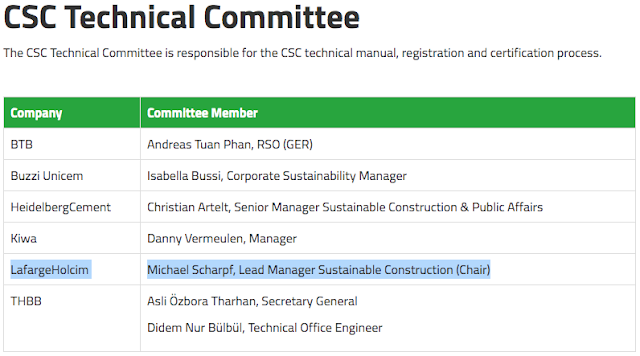
But what about the certification process? That's the responsibility of CSC's Technical Committee; Michael Scharpf from LafargeHolcim is Chair.
OK. But surely CSC's Advisory Committee, "providing the direct voice of social and environmental stakeholder", is free from the hand of LafargeHolcim? You would hope so, but no.
Guillaume Habert is Professor of Sustainable Construction at ETH Zurich, the Swiss Federal Institute of Technology. It is a position funded by LafargeHolcim.
Member companies of the Cement Sustainability Initiative (CSI) and global concrete associations have joined forces to form a unique industry alliance. Its purpose is to develop and operate a certification scheme for the concrete and cement sector. As a result, the Concrete Sustainability Council (CSC) was recently launched in Geneva. LafargeHolcim is proud to be one of the founding members of the CSC.
So, how much is a Gold Certificate worth, when you award one to yourself?
Rio Tinto’s chief executive is facing calls to resign after admitting he did not know the cultural significance of a 46,000-year-old Aboriginal site before the mining group blew it up.
Australian MPs grilled Jean-Sébastien Jacques and other senior executives yesterday over a decision to destroy the Aboriginal rock shelters to access iron ore deposits valued at $135m. The lawmakers criticised their failure to recognise the cultural significance of the Juukan Gorge site and inability to immediately answer multiple questions at the inquiry.
The Anglo-Australian miner told the parliamentary committee its senior executives, including Mr Jacques, had not read a 2018 archaeological report that the company had commissioned. The study found the site was of the “highest archaeological significance in Australia”.
Rio Tinto didn't tell traditional owners there were options to save 46,000yo rock shelters https://t.co/hCtDXp4MqK
Rio Tinto admits that destruction of 46,000-year old Aboriginal rockshelter helped it access high grade iron ore worth $135 million https://t.co/pXmMxO23nu
BREAKING: Rio Tinto’s CEO and two senior executives will depart the company after an investor revolt over the destruction of the ancient Juukan Gorge rock shelters. https://t.co/4avoAYlXwy
#RioTNT finally being called out for being the appalling corporate citizens they are. Rio have always seen themselves above governments.They treated my government with utter contempt. Their disregard for indigenous people now on full display to the world https://t.co/t3MIlMN7Xi
Of course, we should not forget – as we previously posted here – that the parent company of Aggregate Industries also has form in damaging Aboriginal rock art, having been fined $280,000 in 2010.
Across Britain overall, an area of grassland around the size of Dorset (2,505 sq km) and arable farmland almost the size of Bedfordshire (1,121 sq km), were built on with houses, roads and other infrastructure.
Beavers were spotted on the River Otter near Ottery St Mary back in 2013. Last week, the population of "at least 50 adults and kits" won the right to remain following a 5-year study by Devon Wildlife Trust:
🎉AMAZING NEWS🎉 Following the 5 year River Otter Beaver Trial, we are thrilled to announce that Devon's beavers are back and THEY'RE HERE TO STAY! The government has just officially confirmed that beavers can stay in their Devon home!
📸 Mike Symes @WildlifeTrusts@DefraGovUKpic.twitter.com/c5hMpBURFB
It's the first time an extinct native mammal has been given government backing to be reintroduced in England.
Peter Burgess, director of conservation at Devon Wildlife Trust, said:
"This is the most ground-breaking government decision for England's wildlife for a generation. Beavers are nature's engineers and have the unrivalled ability to breathe new life into our rivers."
All those in favour! The good people of Ottery St Mary show their support for Devon's wild beavers. pic.twitter.com/k5Pj2pVT2L
Transparency International UK has warned that major planning decisions across England are open to the influence of secretive lobbying, conflicts of interest and bribery.
Our new report shows how private interests may seek to corrupt major planning decisions through:
- Generous gifts + hospitality
- Lobbying key members in secretive, closed-door meetings
- Hiring serving Cllrs with inside knowledge to help secure consenthttps://t.co/BkAA0BcGqg
Unminuted, closed-door meetings with developers and excessive hospitality undoubtedly undermine confidence in the planning process, yet too many local authorities have weak rules to stop this from happening. Even fewer councils have control measures for major conflicts of interest, with far too many decision-makers also working for developers on the side.
But there's a big difference between talking sustainable and doing sustainable.
For example, the plans put forward by LafargeHolcim’s UK subsidiary for Straitgate Farm must surely rank as one of the most unsustainable schemes for any quarry proposal in the UK.
All sand and gravel quarries put processing plant on or near to site to minimise haulage distances. Aggregate Industries on the other hand proposes to haul each as-dug load from Straitgate 23 MILES to its processing plant in Uffculme; a round trip total of 46 miles for each load, a total distance of 2.5 million miles in all. And all this before any onward distribution of processed material to end markets.
It makes little sense economically. It makes no sense environmentally.
Was anybody at Aggregate Industries thinking sustainability when proposing that? Of course not.
LafargeHolcim's CEO says the company must do better:
Speaking to "Squawk Box Europe", Jan Jenisch was asked about the topics of ESG (environmental, social and governance), how his industry was perceived as being both dirty and energy inefficient, the notion of using government funds to "build back better," and the role LafargeHolcim could play in this.
"In our company it’s clear: we want to be part of that, and we have to improve our operations to be more sustainable," he replied.
In other words, desperate to be part of government-backed infrastructure projects, we will say – not necessarily do – whatever it takes.
But if LafargeHolcim and Aggregate Industries continue to pursue their demonstrably unsustainable plan for Straitgate, it will be transparently clear that no DNA has changed, and all that talk about improving sustainability was just that: talk – more of the same greenwash that we have become so very used to.
LafargeHolcim – "the largest cement producer in the world" and parent company of Aggregate Industries – has recently been tweeting about sustainability: "the main path forward", "the DNA of our company" etc etc.:
Jan Jenisch, CEO @LafargeHolcim : "This will be the main path for us forward. Sustainability has to be the DNA of our company." https://t.co/0Xhlcwrbt6
"The current linear form of economy – based on taking, producing, and discarding – is no longer tenable."@mariaatkinson AM, Sustainability Business Advisor, and Founding CEO, Green Building Council of Australia.#MaterialTalksLivepic.twitter.com/U8CLKJmAyh
“We aim to put sustainable construction at the heart of the recovery,” says Chief Sustainability Officer Magali Anderson. The recording of the virtual event of 23 June organized by #wbcsd is available here 👇https://t.co/iy0yE0skmYpic.twitter.com/lz5i03WDR5
ICYDK: "Cement production, which uses huge amounts of heat and energy, is responsible for 7% of man-made carbon dioxide emissions. If the cement industry were a country, it would trail only the United States and China in emissions of the greenhouse gas."https://t.co/GL3OYUpUfb
Because it's very much easier to tweet about sustainability, than to actually do sustainability.
🟢💰🟢
From major companies making big environmental pledges, to small brands selling 'must-have' sustainable items for extortionate prices - what on earth is greenwashing? And why is it such a problem?
Nowadays, greenwashing is taken to mean two main things. It can be when companies - usually mega corporations - try to hide or cover up their less-than-stellar environmental records with a grand, public gesture towards green causes.
But the other type of greenwashing can be a bit harder to spot, and is far more insidious. This is where companies and brands use words like ‘green’, ‘sustainable’, ‘eco-friendly’, or ‘vegan’ simply as a marketing ploy, without any deep interrogation over what those terms actually mean. And crucially - without any accountability for their actions.
There can’t be many people who can see what the future holds vis-à-vis covid-19 and the impact on the world’s economy – least of all in the uncertain world of construction.
But there is one man.
Jan Jenisch, CEO of LafargeHolcim – parent company of Aggregate Industries – claims:
This is a tsunami crisis and in our case it is already over.
We expect a solid second half of the year based on June’s full recovery, the trend of our order book and upcoming government stimulus packages.
Jenisch doesn’t think a second wave of the virus would derail recovery:
You will see waves and hotspots, but I don’t think construction sites will necessarily be affected by this.
For those following world events, his views might seem surprising. They were to the CEO of competitor HeidelbergCement, who said the future was still shrouded in uncertainty. When asked why his view differed to the boss of LafargeHolcim:
I’m not a fan of phrases, I’m sticking to the facts.
I cannot predict today how the fourth quarter will look like.
We’ve always said that Aggregate Industries has a problem sticking to facts. It looks like the problem goes all the way to the top.
'Sticking to facts': HeidelbergCement cautious after rival says it has weathered storm https://t.co/7SpOsdYm8J
To fight climate change, old buildings should be upgraded, not demolished – urges RetroFirst, a campaign by the Architects’ Journal supported by "more than 100 architecture practices, organisations and individuals".
It was once thought better for the climate to demolish old energy-hungry buildings and build well-insulated replacements. This view is now regarded as mistaken, given how much carbon is emitted by creating the cement, bricks and steel for new buildings:
The Royal Institute of Chartered Surveyors (RICS) estimates that 35% of the lifecycle carbon from a typical office development is emitted before the building is even opened. It says the figure for residential premises is 51%.
These calculations suggest it will be decades before some new buildings pay back their carbon debt by saving more emissions than they created – and these are decades when carbon must be sharply reduced.
Why did XR target the concrete plants?
Climate change: The massive CO2 emitter you may not know about - BBC News https://t.co/1BG2W1IVkS
In the UK, the construction industry accounts for 60% of all materials used, while creating a third of all waste and generating 45% of all CO2 emissions in the process. It is a greedy, profligate and polluting monster, gobbling up resources and spitting out the remains in intractable lumps. On our current course, we are set to triple material extraction in 30 years, and triple waste production by 2100. If we stand any chance of averting climate catastrophe, we must start with buildings – and stop conceiving them in the same way we have for centuries.
— Mineral Products Association (@MineralProduct) August 3, 2020
The MPA reports the impact of lockdown has been worse than the global financial crisis of 2007–2008. In contrast to the views of LafargeHolcim's CEO, who reckons the 'coronavirus tsunami' has passed:
Aurelie Delannoy, Director of Economic Affairs at the MPA, cautioned that the contraction seen so far only reflects the direct impact of the lockdown during April and May, not the overall impact of the pandemic and resulting macroeconomic weaknesses. “While there has been a gradual pick-up in activity since mid-May in England and Wales, much of this reflects post-lockdown pent-up demand. The industry therefore remains concerned about the shape, speed and resilience of the recovery over the next few months, particularly order books throughout the autumn and into the winter.”
Last year, we posted that Tungsten West Ltd had bought the Drakelands tungsten and tin mine at Hemerdon near Plymouth for £2.8 million, with the hope of restarting production.
We have completed initial test work and are now conducting a feasibility study, which is expected to be completed this year or by the first quarter of 2021. We expect to get financed off the back of the feasibility study, with a rebuild time of six months.
It seems to be pinning its hopes on a new processing route, using X-ray transmission ore sorting:
The additional ore sorting step will significantly reduce downstream processing costs, and feed into the concentrator plant, leading to a much cleaner and higher-grade ore.
This week, application DCC/4191/2020 was approved by Devon County Council.
Condition 3 of permission 9/42/49/0542/85/3 allows for the continued winning and working of tungsten and tin and disposal of mineral waste at Drakelands until 5 June 2036.
It must be both embarrassing and galling for Aggregate Industries to watch competitor Tarmac crow about the "record-breaking asphalt surface" it laid at the Silverstone motor racing circuit.
How different it could have been for the so-called "racing circuit experts" from Aggregate Industries. If only it had gone right. If only riders hadn’t been injured when they aquaplaned off the company’s new asphalt at 150mph. If only races hadn’t had to be cancelled. If only the company hadn’t gagged a motorsport journalist. If only it hadn’t been such a PR nightmare. If only all this hadn't happened.
Have you signed up for our 'Resurfacing Silverstone' webinar? Join us as @SilverstoneUK MD Stuart Pringle & our technical manager talk about the complexities of the project and how the approach taken can influence future major road projects. Register here: https://t.co/D3VQXcQOxHpic.twitter.com/iC8DtkfRH0
‘Surfacing Silverstone – Key learnings and reflections one year on’ will provide the inside track on the installation of the iconic Northamptonshire racing circuit’s latest record-breaking asphalt surface.
Tarmac’s technical manager, Tim Smith, will be joined by special guest Stuart Pringle, Silverstone managing director, to explain how the project team worked round the clock to lay a bespoke and highly durable asphalt solution at the world-famous venue.
The session will discuss how Tarmac were able to meet the project’s exacting specification requirements, as well as the cutting-edge technology and processes used to complete the project on time.
This included a UK-first roll out of 3D GPS-guided planing – used to remove the previous track surface and adjust gradients with millimetre precision – running three paving machines in echelon to eliminate joints across the width of the track, and digital paving technology to guarantee quality during the laying and compaction of the asphalt.
Talk about rubbing salt into poor Aggregate Industries’ wounds. But its problems go further.
The team will also reflect on key learnings from the project and how the techniques used could offer practical solutions and improvements in the way that major road projects are carried out in future.
Perhaps they hope that others will now be crying out for Tarmac's expertise, wanting road surfaces as good as the one laid at Silverstone.