Tuesday, 14 September 2021

DCC’s Flood Risk Team withdraws objection –
WITHOUT sight of ‘a plan indicating how exceedance flows will be safely managed’
WITHOUT knowing whether a drainage scheme is even ‘feasible’

Yes, you really did read that correctly. 

an information gathering exercise which follows a prescribed, well established methodology carried out by the developer and which enables a local planning authority to understand the environmental effects of a development before deciding whether it should go ahead.
Without certain basic information the local planning authority is in no position to understand or to make an informed decision about whether permission should be granted. Friends of the Earth point to Judicial Reviews and say: 
Our claims will often question whether the authorities have considered all material factors. 
A plan indicating how surface water would be safely managed would plainly be a material factor and the very minimum a flood risk team should need to understand in order to make an informed decision. 

Six years ago, for Aggregate Industries’ first application to quarry Straitgate Farm, Devon County Council's Flood Risk Management Team – in its role as Lead Local Flood Authority – requested a "detailed surface water strategy": 
This should include detailed design regarding [the infiltration features'] size, details whether infiltration is permitted at the proposed locations and where targeted at areas where infiltration is required to support the spring lines of the existing watercourses (as commented by the Environment Agency), together with details of exceedance pathways. 
The surface water management is inextricably connected to Flood Risk Management/Airport safeguarding and the need to maintain and recharge watercourses. This issue is so important in terms of the likely significant impacts of the proposal the MPA would wish to ensure that a SWM scheme can be designed to meet all of the requirements identified in advance of the determination of this application.  
An issue "so important." A surface water management scheme "in advance of the determination." Not our words – Devon County Council’s. 

Since then, Aggregate Industries has had SIX YEARS to join the dots, SIX YEARS to produce a workable flood mitigation scheme, SIX YEARS to come up with a detailed design. The company has been unable to do so. Click the flooding label for the whole sorry tale. 

Clearly, Devon County Council hopes that poor Aggregate Industries will have more success away from the eyes of public scrutiny. The LLFA – which had previously objectednow says
Our objection is withdrawn and we have no in-principle objections to the above planning application at this stage, assuming that the following pre-commencement planning condition is imposed on any approved permission... 
What condition? The LLFA proposes – only AFTER councillors have voted – that: 
No development hereby permitted shall commence until the following information has been submitted to and approved in writing by the Local Planning Authority: 
(b) The applicant should submit a detailed drainage design... prior to commencement of each Excavation Phase. This should also include the detailed design of the surface water management strategy proposed for the Restoration Stage as well as cross sections of the proposed basins and infiltration testing... 

(d) A plan indicating how exceedance flows will be safely managed at the site. 

(e) A plan indicating how surface water will be managed in the areas which will be stripped for storage of materials.
How on earth can councillors make an informed decision about so important an issue – particularly for downstream flood-prone communities – knowing that the Council’s Flood Risk Team has not even seen "a plan indicating how exceedance flows will be safely managed"? It beggars belief. 

The reason given for these conditions? 
The conditions should be pre-commencement since it is essential that the proposed surface water drainage system is shown to be feasible... 
Yep, you read that correctly too. As things stand, Devon Councty Council and the LLFA have no idea whether a drainage plan at Straitgate Farm is even feasible?

Policy M24: Flooding of the Devon Minerals Plan says proposals for mineral development:
...will be accompanied by a Flood Risk Assessment that must demonstrate that the proposal will be safe for its lifetime taking account of the vulnerability of its users, without increasing flood risk elsewhere and, where possible, will reduce flood risk overall. 
With NO PLAN for "how exceedance flows will be safely managed", and NO PLAN for "how surface water will be managed in the areas which will be stripped for storage of materials", Aggregate Industries' Flood Risk Assessment has very obviously NOT demonstrated that the proposal will be safe.

Monday, 13 September 2021

Straitgate decision postponed again

Aggregate Industries’ planning application to quarry Straitgate Farm will not now be determined in September. The company has again failed to meet an agreed extension.
 
Nine years have passed since Aggregate Industries’ consultants started crawling over Straitgate Farm in preparation for plans to quarry the site. Six years have passed since the company’s initial application. The determination date for the re-submitted application has been extended 12 times. 

There is increasing and justified concern within the community about the length of time being taken to determine this application and the delays in providing requested information. 

This application has now been with the County Council for nearly three years [six years since the initial application] and the uncertainty for the local community is a situation that the County Council as Mineral Planning Authority can no longer accept by continuing to request further delays in the determination due to a lack of the information we have been asking Aggregate Industries to provide. 

I must advise you that any extension of the determination date will now be limited to a reasonable period of time for you to do this work. The County Council will not be requesting a further extension of time beyond the end of this year… 
It was a hollow threat. Two weeks later, Aggregate Industries wrote to the Council "to confirm our agreement to a further extension of time until the 31st March 2021." 

That extension was missed, and on 11 March 2021, the Council offered yet another extension
I am writing to ask you to formally agree to extend the period for the determination of your application until 30 September 2021. You have indicated this will give you adequate time.
This week we found out that it was not adequate time

It's the same old story. Aggregate Industries says one thing and does another. On 7 April 2021, Aggregate Industries wrote to Devon County Council with "our final submission of additional information."

It was not final. On 30 June 2021, Aggregate Industries wrote to Devon County Council with "our final response to the queries raised as part of the consultation." 

That was not final either.

So, where do we stand now, 12 months on from when the Council said no further extensions would be agreed? The next possible date for determination is 20 October 2021.

Thursday, 9 September 2021

BAU is not an option

As far as Aggregate Industries is concerned, the proposal to quarry Straitgate is just business as usual.

In reality, it would be worse than business as usual – when you consider the multi-million-mile haulage scheme, with the processing plant a wholly unsustainable 23 miles away from the proposed quarry face. 

Not one single aspect of the proposal reflects the climate and biodiversity emergency we face. 

However, business as usual is not an option. The UK must cut emissions, and fast: 


On net zero, Aggregate Industries and parent Holcim talk the talk: 


However, the Straitgate proposal shows no intention to walk the walk. Talk of net zero is just greenwash.

Wednesday, 8 September 2021

Holcim faces fresh criminal charges for financing terrorism

Aggregate Industries’ parent company Holcim is in the news again for all the wrong reasons.

It’s over the company’s involvement in Syria – a subject we have posted about before

France’s top court has rejected the cement giant’s bid to dismiss charges of "complicity in crimes against humanity" for financing terrorism in Syria, overturning a previous ruling. 

The company has been accused of paying millions of euros to Daesh/ISIS to keep its Lafarge operation in Syria running. It is also accused of supplying cement to the terrorist group which "is known to have constructed fortified shelters and tunnel networks against the Coalition powers led by the US." 

In its ruling, the Court of Cassation said
In this case, the knowing payment of several million dollars to an organization whose purpose is exclusively criminal is sufficient to characterize the complicity, regardless of whether the concerned party is acting in pursuit of a commercial activity. 
 

Earlier this year, the company changed its name from LafargeHolcim to Holcim in an effort no doubt to distance itself from controversy over Syria – as well as over Myanmarhuman rights and pollution.

Tuesday, 7 September 2021

AI’s application to extend Chard Junction Quarry in Dorset AONB refused

Yesterday, Dorset Council’s Strategic Planning Committee rejected Aggregate Industries’ planning application WD/D/19/000451 to extend the life of Chard Junction Quarry. The company wanted to extract some 830,000 tonnes of sand and gravel from a new site at Westford Park Farm in the Dorset AONB.

Previous posts on this application can be found here

Dorset Council planning officers had recommended that councillors approve the application – despite the proposal's "significant adverse landscape impact on the character of the designated Area of Outstanding Natural Beauty", and despite the NPPF saying that development within AONBs: 
should be refused for major development other than in exceptional circumstances, and where it can be demonstrated that the development is in the public interest.
A last minute letter from Aggregate Industries was sent directly to members of the committee in response to a damning technical review by an independent quarry design expert commissioned by objectors. Amongst other things, the expert claimed: 
...revised Application Plans incorporates some fundamental design flaws which mean that the scheme as it stands is not capable of being developed into a detailed design that would comply with the provisions of the Quarries Regulations 1999. 
The expert also raised questions over a culvert that had the potential to restrict the flow of a watercourse, "unless carefully designed." This seemed to irk the author of Aggregate Industries' letter, who retorted with "why on earth would we design something uncarefully?" 

But we all know that this is exactly what has happened for multiple parts of the company’s proposal to quarry Straitgate Farm – including, coincidentally, reliance on a small, easily-blocked 3rd party culvert for surface water drainage of a large part of the site. Aggregate Industries does not have a good track record here of relying on assets that do not belong to them. Readers will remember that the company's first application for Straitgate was withdrawn in 2016 after it made the careless error of failing to check it had the necessary rights over 3rd party land

For the Chard Junction application, Aggregate Industries’ panicky letter failed to persuade councillors, who were left unconvinced there were exceptional circumstances that would warrant such harm to the AONB – particularly given that around 90% of the extracted material would be for the decorative market. One councillor pointed to the NPPF's newly included reference to the UN’s 17 Global Goals for Sustainable Development, and to the reference that sustainable development means "using natural resources prudently". 

Councillors voted to reject the application by 6 votes to 3. How refreshing to see sense prevail.

Monday, 6 September 2021

Why is soil conservation important?

It takes 200 – 400 years to create 1 cm of new soil; it takes around 3,000 years to make a soil fertile

Soil is therefore considered a non-renewable resource: once it has been destroyed, it is lost forever

humanity must now produce more food in the next four decades than we have in the last 8,000 years of agriculture combined
Countries can withstand coups d’état, wars and conflict, even leaving the EU, but no country can withstand the loss of its soil and fertility. 
In 2014 Sheffield University researchers said that UK farm soils only had 100 harvests left in them, and a year later a UN spokesperson warned that at current rates of degradation, the world’s topsoil could be gone within 60 years.
 A recent study warns that soil erosion will increase because of climate change:


Aggregate Industries' proposal to quarry Straitgate Farm has prompted renewed concerns from Natural England about the storage of soils – topsoil, subsoils and overburden – soils that currently form best and most versatile agricultural land. These concerns have not been addressed. The Devon Minerals Plan states "a proposal affecting the best and most versatile land should provide for the restoration of the land to its former quality." Click on the soils label for more detail.

Friday, 3 September 2021

AI’s loading area would be UNDERWATER too

The central hub of any quarry at Straitgate Farm would be the loading area. 

Deciding its location would have warranted some careful consideration. Or so you would have thought. 

Aggregate Industries has proposed a "50 X 50M LOADING / STOCKING AREA / LORRY PARKING": 
The mineral would be loaded into articulated dump trucks for transport to the designated stocking area where it would be placed in temporary stockpiles pending export off site. The sand and gravel would be taken by articulated HGVs to Hillhead Quarry for processing. 1.5.3  
A parking area for quarry vehicles will be established within the loading area to the north of Straitgate Farm. 3.1.5
The loading area is where much activity would take place. It has obviously been positioned centrally in the site, furthest away from neighbouring properties. The plan is to surround it with 5m high piles of overburden. These piles, together with the piles of topsoil and subsoils, would not only be required to restore the site back to best and most versatile agricultural land – if that were possible – but would also act as noise attenuation and screening. As the Good Quarry Entrance Design Handbook remarks: 
Many quarries are located in the countryside; the introduction of noise into a rural context can be an impact in itself; it can draw attention to the quarry entrance and to have a cumulative effect with other impacts. Noise is most likely to be a regular source of complaints when the quarry and especially the processing and loading areas, are located near to residential property. 
Noise calculations have been performed for the Straitgate application based on the loading area location: 
HGV movements are included in the site noise calculations, at a two-way flow of 16 HGV movements per hour, on the quarry access road between the stockpiling / loading area and the new access onto Birdcage Lane, which links in to the B3174 Exeter Road. 11.2 
The location of the loading area and soil mounds has implications for dust and visual impact too. 

Last month we posted that Aggregate Industries had overburden storage problems. Groundwater is close to the surface in the areas where it is proposed to store overburden – areas where topsoil and subsoils would first need to be removed, potentially breaching the maximum water table. No groundwater monitoring has been carried out in these areas. The Environment Agency has proposed a condition that working should be no lower than the maximum water table.

But, of course, it’s not just the overburden storage areas where the maximum water table could be breached – it would be the loading area too. 

And readers will hardly need us to point out what would happen when the water table rises above the elevation of the loading area. Not only would quarry vehicles be adding goodness knows what contamination to groundwater, but water would also gush down the sloping haul road, adding to any surface water run-off at the time, with obvious flooding implications – as yet unassessed. 

Has Aggregate Industries been aware of this risk all along, hoping no one would notice? It’s hard to believe the company didn’t know, given it has been preparing for this planning application since 2012. 

Or is the company just inept in the fundamentals of quarry design – something so central to its business?

Whichever it is, Aggregate Industries is clearly not taking water at Straitgate seriously enough – be it groundwater or surface water – as we have shown time and time again. 

And water is a serious subject. Get it wrong and not only would the wider community suffer, but we could be seeing scenes like this:

Autumn will bring an increased risk of flooding... says AI


Indeed, SuDS do have a major role to play. At Aggregate Industries’ very own proposal to quarry Straitgate Farm, SuDS would be needed to protect downstream communities from flooding.

Aggregate Industries’ Updated Flood Risk Assessment for Straitgate – which at now at almost 5 years old has not been updated, and has not been informed by the elevated groundwater levels recorded at the site, nor the revised maximum water table contours – says: 
The DCC Minerals SFRA states that suitable Sustainable Urban Drainage Systems (SuDS) strategies should be employed within Mineral Development Sites so that surface water runoff rates are managed to greenfield rates. 4.1.3 
However, as it stands, Aggregate Industries' SuDS scheme at Straitgate is unworkable – runoff rates would not be managed to greenfield rates – click on the flooding label for more. 

But whilst we’re on the subject of Aggregate Industries and protecting, do take a look at what the company planning a multi-million mile haulage scheme for Straitgate is doing to protect the planet ♻️.


Of course, Aggregate Industries would still rather we did not read such claims. No idea why.

Drakelands operator strikes secondary aggregates supply deal

GRS has joined forces with Tungsten West, operator of recently reopened Hemerdon tungsten-tin mine near Plympton, Devon, in a multi-million pound venture to sell high-quality secondary aggregate and transport it nationwide mostly by sea and rail. 

Starting this month, GRS expects to ramp-up secondary aggregate volumes from Hemerdon to distribute more than a million tonnes each year for the next decade and beyond, the company said. After a 10-mile lorry journey from Hemerdon, the aggregate will be loaded onto ships at Plymouth for transportation to other ports around Britain. The aggregate will also be hauled five miles to nearby Marsh Mills where it can be loaded onto trains for onward distribution via the rail network. Through its Cornish subsidiary Maen Karne and London-based business Walsh, the GRS Group already transports secondary granite from the Cornish China Clay industry into London by sea and rail.

Wednesday, 25 August 2021

Springs appear when groundwater levels are high

For anyone wondering why a spring might appear in the area Aggregate Industries has designated for the storage of overburden, as we recently posted about here and here – an area where, to facilitate like-on-like soil storage, the company would first have to excavate topsoils and subsoils without breaching the maximum water table – the following rainfall anomaly maps should provide a clue:
Groundwater measurements were taken from all the boreholes around Straitgate Farm last week by consultants working on behalf of Aggregate Industries. The groundwater level in at least one borehole was as high as 2014 levels for the same time of year – 2014 being the year when most of the highest water levels were recorded at the site, even though there were only 6 boreholes around the proposed extraction area – not the current 13, with another 5 further afield.
 

Why are summer groundwater levels important? Aggregate Industries' unorthodox, untried, untested, seasonal working scheme relies on groundwater levels falling by at least 1m during the summer. We have pointed out that there are several areas where this seasonal scheme can't work

Will we be told if any of the other boreholes have recorded particularly high groundwater levels this summer? No. In 2018, when its model of the maximum water table – which had been "defined with confidence" and "builds in a conservatism" – was exceeded in four places by up to 1.6m, Aggregate Industries in its embarrassment put a stop to the public scrutiny of groundwater data for the Straitgate application, "in-line with company policy". 

AI has not assessed the impact of climate change on groundwater

The aquifer at Straitgate Farm supplies many people with drinking water.

For a proposal that would permanently remove a large part of the unsaturated zone above the aquifer, and permanently change the landscape, it beggars belief that neither Aggregate Industries nor its hydrogeology consultants have considered the effect of climate change on the groundwater at Straitgate.

In fact, the number of occurrences of the word climate in Aggregate Industries’ Hydrogeological Assessment is precisely zero. It’s a big omission.

It is an irrefutable fact that our climate is changing, that rainfall patterns are changing
The overarching picture is warmer, wetter winters; hotter, drier summers
It is important that project designers incorporate climate resilience into the design of the project at an early stage. This means evaluating what resilience measures may be appropriate to include in the design, and this should take place at all stages of design development – from optioneering through to detailed design, not just as a part of the EIA process.
Whilst Aggregate Industries has not considered the impact of climate change on groundwater levels at Straitgate, Professor Brassington has. His Note on the impact of climate change on the proposed quarrying at Straitgate Farm has now been submitted to Devon County Council: 
The main impact of climate change will be the fact that the winter water table will be at a higher elevation than it is now. If this planning permission is granted a common-sense view would be that the rise in the water table that will happen caused by climate change should be accommodated by adding an additional amount to the calculations to account for the additional recharge and the water table rise. 
Of course, the water table at a higher elevation could obviously affect surface water run-off and flooding to downstream communities; the water table at a higher elevation could leave parts of the restored landscape underwater and unfarmable. Aggregate Industries' consultants have assessed none of this.

And there's another problem. Prof Brassington has already warned that the proposal would permanently change the chemistry of the groundwater, making drinking water sources forever too acidic. In this new report he warns that climate change will exacerbate the problem. 
The proposal to remove the unsaturated zone will halve the time available for rock-water interaction which is the main process by which the pH of the water is neutralized from an acidic value of some pH 4.5 which will mean that the water will not be fit for drinking. As a result of the factors discussed in this report, climate change will exacerbate the problem. The BSPB aquifer in the Straitgate Farm area must be regarded as a fragile groundwater system because it lies at the upper end of an aquifer that has springs located only a short distance from the recharge area. 
Prof Brassington concludes: 
The simplest thing would be for the planning authority to refuse permission. 
And who can argue with that?

More greenwash from Holcim

The world’s largest cement producer is greenwashing again:
 

What Aggregate Industries' parent Holcim fails to mention is the industry’s monstrous CO2 emissions:
 

So, is concrete the ideal sustainable material for our future? Clearly this prize-winning writer doesn’t think so, in fact quite the reverse:
 

Some wonder if the cement companies are deliberately keeping us addicted to concrete:
 

As for all the sand needed to make concrete:
 

Monday, 16 August 2021

EA maintains ‘no objection’ – despite warnings from award-winning Prof, despite not knowing ‘workability’ of S106, despite being unsure of base & extent of workings

It really is shocking – embarrassing even – that after all these years, the Environment Agency plainly still can’t get its head around Aggregate Industries’ plans to quarry Straitgate Farm. 

In its latest response, which continues to offer no objection, the Environment Agency seeks clarification on the central and most fundamental aspect of the proposal: 
we request clarification as to whether the February 2021 Maximum Winter Water Table (MWWT) contours are the same as the contours of the intended quarry base.
Firstly, many will wonder how, without knowing the elevation of the base of the proposed quarry, the Agency could possibly be in a position to produce a reliable response on the impact to groundwater. 

Secondly, by seeking such clarification, the Environment Agency provides ample evidence to show it isn’t fully familiar with Aggregate Industries' planning application, because such information is already contained in a number of documents, such as:
In the Non-Technical Summary, 3.8: "The depth of working is set by the level of the maximum winter water table." 

In the Supporting Statement, 2.4.7: "The resource declared assumes a working base that coincides with, and never drops below the Maximum Winter Water Table (MWWT) modelled by hydrogeological specialists AMEC Foster Wheeler following extensive monitoring and analysis since January 2013." 

In the Hydrogeology Assessment, 1.1.3: "Mineral will be worked down to a level defined by the maximum winter water level and then a layer of overburden replaced." 

In the Hydrogeology/Drainage Reg 22 responses, 2.2.1: "...the Maximum Winter Water Table (MWWT) used as the basis of extraction models,..."; 2.2.8: “... derived from the MWWT (i.e. the final proposed depth of working)..."; 2.4.6: "The quarry will be worked dry and down to a level defined by the maximum winter water level...". 

In the Hydrogeology/Drainage Reg 22 response, Appendix C: "... will be extracted to the MWWT." 

In the Resource Assessment, February 2021, 2.1, "The MWWT will ultimately form the base of the workable deposit, and any variation will impact the potential resource." 

In Aggregate Industries' letter, April 2021: "In respect of the revised Mineral Resource Assessment based on the latest modelling of the Maximum Winter Water Table the revised figure of the reserve is still over 1 Million saleable tonnes...". 
But it’s not only the depth of the proposed quarry that the Environment Agency isn’t clear on, it’s also the extent – advising Devon County Council: 
we suggest that your authority may wish to consider whether you want to see an updated plan of the extent of the extraction area (taking into account the near-surface MWWT contours in the north- east part of the proposed excavation area) prior to determination. 
However, if the Environment Agency had been up to speed, they would know that Devon County Council had already asked Aggregate Industries this very question, and the company argued that despite such near-surface MWWT contours "The extraction area... remains unchanged."

The Environment Agency isn’t clear on the "workability" of the S106 either, happy to continue to offer Aggregate Industries "no objection" whilst not knowing how or even if alternative water supplies could be provided – to more than 100 people, livestock farms, businesses, Grade I listed Cadhay and its mediaeval fishponds, wetland habitats in ancient woodlands – advising the Council: 
We recommend that your authority obtains legal opinion on the workability of the proposed S106 agreement.
The Environment Agency was also told about the threat to groundwater in the proposed overburden areas, but, despite being the guardians of our precious groundwater, not a mention in the response. 

And yet, despite these failings, and despite still seeking clarification on the extent and depth of the proposed quarry, the Environment Agency feels sufficiently competent to entirely dismiss all the warnings from Professor Brassington, an eminent authority in the field

How on earth could Devon County Council possibly rely on the Environment Agency’s conclusions when they are so clearly flawed?

Tuesday, 10 August 2021

Chard Junction Quarry

Aggregate Industries’ planning application WD/D/19/000451 for an extension to Chard Junction Quarry in the Dorset AONB has been the subject of a number of posts.

The application is to quarry some 830,000 tonnes of sand and gravel, "approximately 90%" of which would be for the "decorative market." Dorset Council planning officers recommended approval – despite the fact that "Great weight should be given to conserving and enhancing landscape and scenic beauty in... Areas of Outstanding Natural Beauty which have the highest status of protection", and despite the proposal's "significant adverse landscape impact on the character of the designated Area of Outstanding Natural Beauty". How screwed up is that?
However, determination has been delayed following discovery that "officers had sent the notification to an old email address for the Tatworth and Forton parish council." That parish council has now "resolved to strongly oppose the planning application", one reason being: 
1. As it is a major new development in an Area of Outstanding Natural Beauty (AONB), paragraph 172 of the National Planning Policy Framework applies. This states that such a development must meet an ‘exceptional circumstances’ test. Since the need for the stone is not primarily for construction but for decorative purposes, the Council considers there is not a sufficient reason for severely damaging an AONB. 
Hear, hear. The parish council also pointed to the support from Devon County Council, saying: 
Devon Council supports this application, but says that "if permission were refused the knock-on effect for Devon is likely to be quite small."

UN climate change report sounds ‘code red for humanity’

"The alarm bells are deafening," warns UN Secretary-General António Guterres.

 
How is this urgency reflected in UK planning? On 20 July 2021, a new version of the National Planning Policy Framework was released. We posted about it here. The NPPF sets out the government’s planning policies for England and how these are expected to be applied. 

According to this article, the term "climate change" appears three more times than the predecessor document published two years before. The NPPF has not been updated to reflect the UK’s 2050 net zero obligation approved by Parliament in 2019. The section on "planning for climate change" still reads: 
152. The planning system should support the transition to a low carbon future in a changing climate, taking full account of flood risk and coastal change. It should help to: shape places in ways that contribute to radical reductions in greenhouse gas emissions, minimise vulnerability and improve resilience; encourage the reuse of existing resources, including the conversion of existing buildings; and support renewable and low carbon energy and associated infrastructure. 
However, reference to the UN’s 17 Global Goals for Sustainable Development has been added to the NPPF, and the paragraph which defines sustainable development in more detail has been toughened up with "much more binding" language about protecting and enhancing the environment: 


Nevertheless, it seems a meagre response to the crisis we now find ourselves in. This editorial argues: 
Without an accelerated reduction in greenhouse gases during the next decade, the ambition of the 2015 Paris climate agreement to limit global heating to 1.5C will not be met. The price of failure will be a world vulnerable to irreversible and exponential effects of global heating: there will be worse floods more often, more terrible and frequent heatwaves and devastating and repeated droughts. 

The science is irrefutable. Less certain is the strength of political will to act upon it. An awesome burden of responsibility now rests upon this generation of leaders as humanity finds itself at a fork in the road. The actions taken or foregone during the next 10 years will define the parameters of the possible for future generations. A step-change is required, but across the world green rhetoric continues to translate into policymaking at a pace which is fatally slow.

How has Holcim, the world's largest cement producer responded to this dire warning, given that cement is responsible for about 8% of CO2 emissions? Just as if it has played no part at all:
 

This of course is the same company that in 2020 alone pumped out 146 million tonnes of those greenhouse gas emissions choking our planet, the same company that would ultimately profit from the multi-million-mile-CO2-belching-haulage-scheme planned for Straitgate Farm. The hypocrisy.

‘With the risk of #flooding increasing, it's vital that planners take pre-emptive action’

... says Aggregate Industries. 

How ironic then that the company’s flood mitigation plans for its planning application to quarry Straitgate Farm are in such disarray, with Devon County Council’s Flood Risk Management Team indeed having to take pre-emptive action, with an objection to the proposal lodged in May this year.


Of course, it is the CO2 emissions from Aggregate Industries – and the monstrous emissions from parent Holcim and other polluters – that are forcing planners to take such pre-emptive action and review their flood defence strategies.

Monday, 9 August 2021

Devon Garden Trust maintains objection to Straitgate proposal

Aggregate Industries’ "final response" for its planning application to quarry Straitgate Farm has not persuaded Devon Gardens Trust to lift their previous objection to the proposal.

Last week, Devon Gardens Trust – part of The Gardens Trust, and statutory consultee on development affecting registered parks and gardens in Devon – wrote
On the basis of the supplementary documents now provided, we conclude that, if implemented, the proposed scheme would cause more than substantial harm to the Grade II designed landscape at Cadhay, which forms the designed setting for the Grade I house. This level of harm to two, inter-related, nationally designated heritage assets, clearly conflicts with Government planning guidance contained in the National Planning Policy Framework (especially paras 193-195), and with local and County planning policy. 

In these circumstances we urge your Authority to withhold consent for this highly detrimental proposal.

Friday, 6 August 2021

More overburden storage problems

According to Aggregate Industries, 159,000 cubic metres of overburden material from above the sand and gravel resource would need to be stored elsewhere on site in 5m high mounds if Straitgate Farm were to be quarried, material that would in time need to be restored. 

The issue of soil storage is important. The Devon Minerals Plan states "a proposal affecting the best and most versatile land should provide for the restoration of the land to its former quality." Natural England had asked for more information on the storage of subsoils, information that was not supplied

The different categories of retained soils must be stored like-on-like. Overburden can only be stored on overburden. Topsoils and subsoils S1 and S2 would first need to be removed from those storage areas, and stored elsewhere. At the same time, in line with proposed conditions from the Environment Agency, "no working shall be undertaken below the ‘Maximum Winter Water Table (MWWT) grid’" or "closer to the contemporaneous measured groundwater level than 1m." 

We have recently posted that – in the middle of summer – a new spring was discovered exactly where Aggregate Industries wants to stockpile 82,000 cubic metres of overburden in the area designated OB1. The new spring is close to the borehole location SG21/90 where groundwater was recorded just 1.26m below the ground surface in June 1990. 


However, there’s clearly a further problem. The geological plan shows groundwater close to the surface in the other area designated for overburden storage, OB2, where Aggregate Industries wants to stockpile another 77,000 cubic metres of overburden. Borehole SG12/90 recorded groundwater at 1.59m below the surface – again in the middle of summer, in June 1990. 

The EA has stipulated that these 1990 groundwater levels should inform the application

There is clearly an unmistakable pattern beyond the eastern boundary of the extraction area, along the geological fault line, exactly where Aggregate Industries wants to store overburden. 


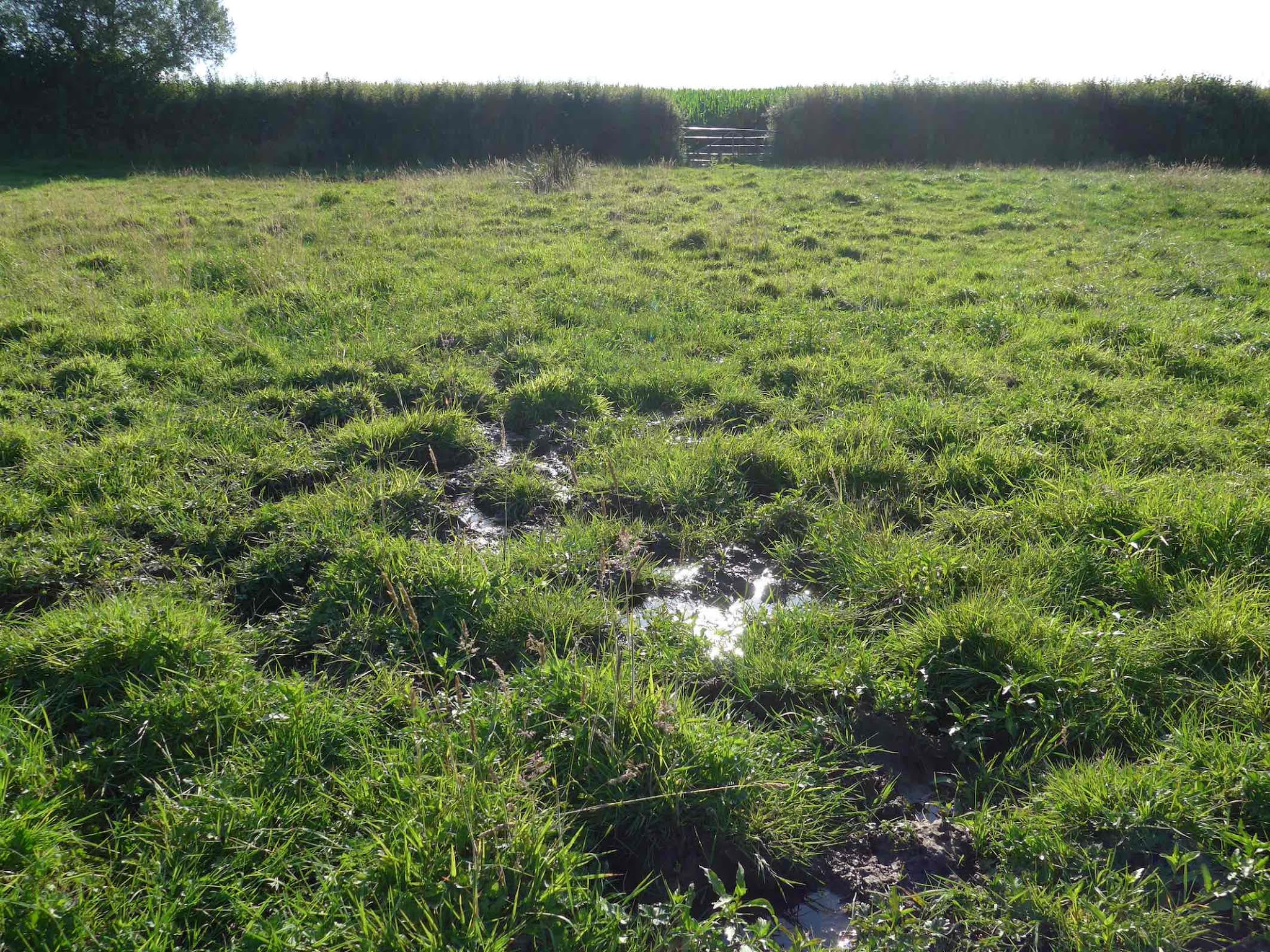
This is a photograph of another spring, issuing to the north of the planning red line boundary as indicated at the top of the above plan, taken just last week. 


So, where could overburden be stored where the removal of topsoils plus subsoils would not breach the maximum water table, where groundwater would be at least 1m below any working? Given that no groundwater monitoring has been carried out in the proposed overburden storage areas, no one knows.